Video
This month's photo video is accompanied by "Comfortably Numb" by Pink Floyd and David Bowie:
June 28th 1220 GMT Sun
There was some activity on the Sun in hydrogen alpha light but it took a lot of processing to tease it out of the photo.
June 28th 0200 GMT Jupiter’s Moons
It had been wet all day. I was never quite in the right
place at the right time to do a solar shoot. However, the sky cleared a bit in
the early morning. As there was a lot of thin cloud and dawn was already
breaking, I decided that I would only photograph Jupiter’s moons and leave
Saturn well alone. I used my DSLR at the usual settings.
I
thought it might have been possible to capture details on Jupiter’s surface
through a telescope, it was late and I was tired.
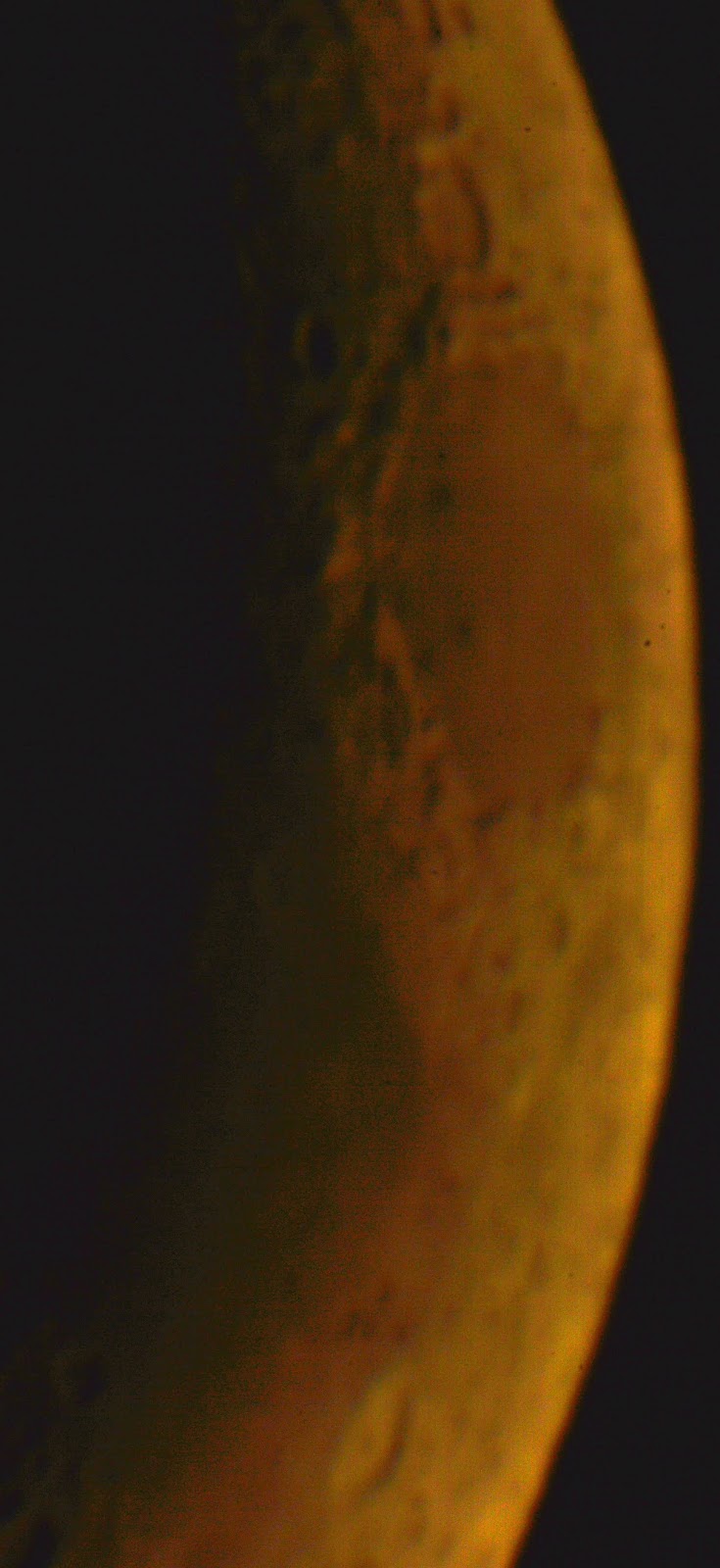
June 26th 2045 GMT Moon
We all dream of clear nights, with a fresh summer breeze and
plenty of time to do full sets of shots of the Moon and planets. On a moonless
night our attention may wander to constellations, deep sky objects or even the
odd meteor. I don’t believe in fairy tales either! It was a case of catching
the Moon between periods of cloud. I took some full disc shots using the same
settings as the evening before.
June 25th 2110 GMT Moon
I was hoping to do a full lunar shoot as the day before but
cloud had started to move in. I just used my DSLR at 300mm focal length, ISO
100 and 1/200 second exposure.
June 25th 1200 GMT
I
had another go at the Sun, as the day before, hopefully with cleaner lenses.
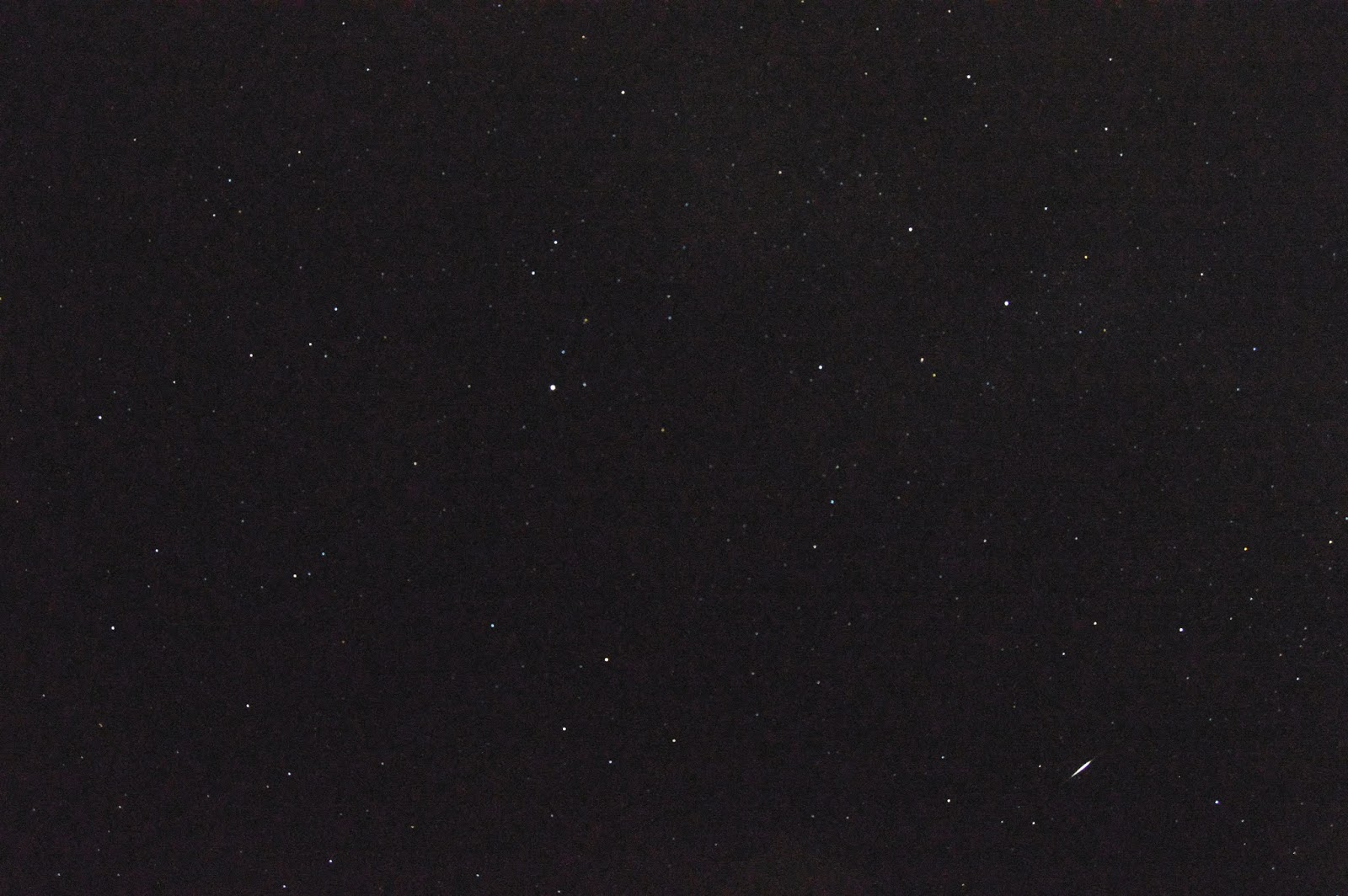
June 25th 2350 GMT Meteor Hunt
I used my usual settings and aimed at the zenith in the hope
of catching some sporadic meteors.
I caught one at 2352 GMT.
I caught a much fainter one at 0051 GMT.
... and an even fainter one at 0059 GMT.
June 24th 2250 GMT Jupiter and Saturn
I tried to shoot Jupiter and Saturn using my Mak and DSLR. I
used the same focus point as I did for my lunar close-up shots. Unfortunately,
these did not work as I was unable to find either planet with such a long
effective focal length.
I used ISO 100 and 1/50 second and 1/20
th second
to attempt to capture the planetary discs. I had no luck with Jupiter. I got Saturn's rings.
I used ISO 6400 and ½ second exposure to attempt to capture
the planetary moons.
Jupiter's came out quite well.
The largest blob to the upper right of Saturn was Titan. I did not know which of the smaller dots were moons and which were background stars.
As a proof of concept, I used these settings on Melotte 20
to see what I could capture. The results were inconclusive. I intended to try another time when the conditions were better.
June 24th 2120 GMT Moon
I had taken too many lazy shots of the Moon, using nothing
but my DSLR. I redressed the balance by doing a my first decent Moon session
for ages. I used my Mak and DSLR.
My first set of frames was of the full lunar disc and were
taken at ISO 100, 1.54 metres focal length and 1/50 second exposure.
I took further sets of frames at ISO 100, 4.62 metres focal
length and 1/6 second exposure. These produced lunar close-ups. I tried to stitch them but it did not work.
June 24th 1210 GMT Sun
Although there was a lot of truth in the quality of my Sun
photos was mostly due to the lack of solar activity, I still felt that I could
do better with what equipment I had. I was having a busy day, so did not have
enough time to experiment as much as I wanted to but I had a trick up my sleeve
to try. I used a shorter focal length eyepiece (15mm) with my Coronado PST. I
reverted to automatic camera settings for the time being.
I saw some albedo features on the solar disc with this
set-up and took several full-disc shots.
As a proof of concept, it worked well but I had a stark reminder to clean by lenses.
June 23rd 2310 GMT Planetary Moons and Meteors
It was not quite as clear as the preceding light and it was
still twilight. I snapped Jupiter and Saturn at the usual DSLR settings in an
attempt to capture their moons. I caught two of Jupiter's but the Saturn shots were blank.
I then proceeded to do a meteor scan.
I bagged a bright sporadic in Draco at 0026 GMT.
June 22nd 1020 GMT Sun
There was a thin layer of cloud but I decided to try a bit
of solar hydrogen alpha photography. Superficially, as the day before, the
solar disc looked bland. I tried some new parameters.
I used my 32mm eyepiece for afocal projection. I used my
DSLR at 55mm focal length and ISO 800. I tried two sets of exposures at 1/30
second exposure to capture disc detail and 1/8 second in case there were any
prominences. The result was less than satisfactory but a quiet sun did not help.
June 22nd 0105 GMT Meteor Hunt
Yes, it was time. I aimed my camera at the zenith using my
usual meteor hunting settings and took multiple shots.
I did not catch any meteors but then I caught one earlier in the evening without trying.
June 22nd The Quantum God
I released my first novel:
Whilst there is no content related directly to observational astronomy nor astrophotography, the main character is an amateur cosmologist and attempts to connect relativity and quantum mechanics to religion. He argues the case for theism, whilst acknowledges that most peoples' religious beliefs are determined by their place of birth and the culture of their family and peer groups.
And what of luck? It is random factors working in one's favour.
June 22nd 0000 GMT Planetary Moons and Deep Sky
I used two camera settings for this session and also used my
binoculars to help hunt down some objects. For widefield I used 70mm focal
length, ISO 6400 and 8 seconds exposure. For close-ups I used 300mm focal
length, ISO 6400 and 2 seconds exposure.
First was Jupiter. I was really pleased with this, as it was very sharp.
Then Saturn but I did not detect any saturnian moons.
I had another go at M80, a globular star cluster in
Scorpius. I could not find it on any of my images. On reflection, it would be a very difficult "pot" for my equipment from the southern UK but I think I should have attempted it earlier in the year. I did not see it in my binoculars either.
Next up was trying for M8 and M20 in Sagittarius.
This frame clearly missed the target but the Milky Way background was quite nice.
That was that, as further frames also missed the target and were less interesting anyway.
I ended with the Wild Duck Cluster (M11) in Scutum. I saw it
clearly on the photos, so I took multiple frames with the intention of
stacking.
One frame was a total surprise, as it contained a meteor. Thjs was ironic, as I performed a meteor hunt later in the night. It was at 0026 GMT.
The bad news that I thought I had caught my target but after processing the photo and checking it against other photos of M11, it was clear that I had caught something completely different and I did not recognise it.
June 20th 1035 GMT Sun
There was a rare clear patch in the sky and I checked out
the Sun with my Coronado PST. The disc was very bland but I hoped that my
camera might have caught more detail than my eye.
June 17th 2315 GMT Planetary Moons
As predicted, the conditions were poor. Although many stars
were visible, there was a lot of patchy cloud, preventing any constellation
shots and deep sky shots.
I
focussed my attention on Jupiter and Saturn, both low in the south east. I used
my normal deep sky settings on my DSLR of 300mm focal length, ISO 6400 and 2
seconds exposure.
I did not photograph Titan but caught two of Jupiter's moons.
June 15th 2305 GMT Meteor Hunt
I
aimed my camera overhead, set at 18mm focal length, ISO 6400 and 6 seconds
exposure.
I caught a meteor at 2320 GMT.
I caught another one at 2335 GMT.
June 14th 2250 GMT Jupiter and Deep Sky
The main purpose of the session was to get some good frames
of M4, the globular cluster in Scorpius. However, although Jupiter (but not
Saturn) had risen above the objects on the horizon, I tried for a shot of its
moons first.
Next, as planned was M4. I took 10 frames and was pleased with the result.
I had a go at M80, another globular cluster in Scorpius,
although it is smaller and fainter, so was a tough punt. I didn't get it.
I also did some horizon grazing in the vain hope of catching
the southern open clusters M6 and M7.
No luck there, either!
June 14th 0000 GMT Jupiter, Saturn and Deep Sky
I went out with my binoculars and was dismayed to find that
my main area of interest, Scorpius and Sagittarius were blocked by cloud. I
really wanted another go at M4. However, I could see all four of Jupiter’s
Galilean moons quite clearly. I also had a look at M31 and Melotte 20 but
rushed back in before Jupiter and Saturn were engulfed by cloud.
I set my camera at 300mm focal length, ISO 6400 and 2
seconds exposure. First up was Jupiter.
Then Saturn. The small dot near it was Titan and I could confirm this, as it had moved since the night before.
I saw little point in doing another shot of Jupiter and
Saturn together, as their relative positions were almost exactly the same as
the night before.
Instead, I went for Melotte 20, which showed quite well,
despite the poor elevation.
I had difficulty pinning down the Wild Duck Cluster (M11)
and not sure I had captured it. I didn't!
The same went for M13, the globular cluster in Hercules. No luck there, either.
There seemed little point in doing another M31. I decided to
wait for a clearer night and/or when it was higher in the sky.
June 13th 1040 GMT Sun
I bin scanned the Sun but the sunspot had faded below the
resolution of my binoculars.
Fortunately, it had already shown up in my hydrogen alpha telescope. See below...
June 13th 1020 GMT Sun
It took several attempts to photograph the Sun in hydrogen
alpha light, dodging the clouds. I experimented with manual settings of my
camera and used 45 and 55mm focal lengths, ISO 400 and various exposures from
1/50 to 1/10 second. I caught the sunspot.
June 13th 2345 GMT Jupiter, Saturn and Deep Sky
The weather had been awful but I found a rare period of
clear(ish) sky, I did a quick photo shoot without many multiple frames to grab
what I could before cloud moved in.
My primary target for the session was Jupiter’s moons. I
started off with my DSLR at 300mm focal length, ISO 6400 and 2 seconds
exposure. At first the photo suggests that the moons were out of focus but they were configured in pairs, with both pairs on the same side of the planet,
I also tried to capture Saturn’s moons. The widefield view did not provide any conclusive evidence that I had captured any moons.
I adjusted the focal length to about 200mm to get Jupiter
and Saturn into the same field of view.
I had a go at the Andromeda Galaxy (M31). I stacked four frames and ended up with a good early season shot.
I widened the field of view by reducing the camera focal
length to 70mm and increased the exposure time to 8 seconds.
First up was the constellation of Cassiopeia.
The next area was around Scutum.
A single shot showed the Wild Duck Cluster (M11). It is the bright "star" towards the bottom left.
My next target was Scorpio around Antares. That bagged the globular cluster M4.
I tried a bit further south. I caught the Lagoon Nebula (M20).
I ended up with Canes Venactici.
June 12th 1235 GMT Sun
The sunlight was battling various layers of cloud to get through. I bin scanned the Sun and caught a faint indication of the sunspot.
June 10th Being An Astronomer
June 9th 0925 GMT Sun
I could not make out the sunspot in my filtered binoculars
and the Big Bear images suggested that it had faded.
I attempted to snap it with my Mak and DSLR ay 1.54m focal
length, ISO 100 and 1/1000 second exposure. Unfortunately, the optics were dirty, so I cropped out most of the solar disc to show the sunspot region only.
I made a drawing from the photo to show the position of the sunspot.
I followed it up with full disc afocal shots using my PST. Unfortunately, cloud rolled in and I was not able to get any "clean" images.
June 8th 1620 GMT Sun
There was lots of moving cloud around, so I did a binocular scan. The sunspot had apparently grown but that was due to rotational effects and not real effects.
June 6th 2245 GMT Moon
The Moon was low down in the south east. There was a lot of
moving cloud around, so a quick shot was the best I could do before it was lost
to cloud. I used my DSLR at 300mm, ISO 100 and 1/320 second exposure.
June 5th 2145 GMT Moon
Conditions were quite similar to my earlier solar observation, so I caught the Moon with my DSLR at 300mm focal length, ISO 100 and 1/500 second exposure. It was a classis full moon.
June 5th 1210 GMT Sun
A sunspot had appeared but the weather was moving cloud. At my third attempt to see the sunspot through my binoculars and filters, I finally saw it. It was small but like seeing an old friend.
June 2nd 0045 GMT Jupiter and Saturn
I decided to have a quick shot of Jupiter’s moons and used
the Moon to achieve accurate focus. I used my DSLR at 300mm focal length, ISO
6400 and 2 seconds exposure.
I also had a go at snapping Jupiter and Saturn, given some
recent success with Venus. I used 300mm focal length and ISO100. With Jupiter I
used 1/50 second exposure and with Saturn I used 1/16 second exposure.
As a proof of concept, it had some promise but it reminded me of why I use a telescope!
June 1st 2145 Moon
First photo of the month was the Moon with my DSLR at 300mm, ISO 100 and 1/320 second exposure.