Saturday, February 3, 2024

February 2024

February 29th 1910 GMT Jupiter's moons 


It was hardly clear but I poked my head out the back door and saw Procyon and Sirius. Jupiter was high in the west and I tried to capture its moons.


February 24th 2110 GMT Moon 


Despite a clear late afternoon, it was very hazy and only the Moon and brighter stars were visible. I used my DSLR at 300mm focal length, ISO 100 and 1/1600 second exposure.


February 24th 1600 GMT Sun


The sky unexpectedly cleared and the Sun was low, two low to catch with my telescope. I saw the two sunspots I had seen in the past few days but the smaller one was probably invisible as it rotated closer to the edge of the solar disc.


February 23rd 2200 GMT Moon 


It was clear  so with a nearly full moon. there was only one object worth photographing. As the Moon was high in the sky, I needed to be a contortionist to photograph it. I gave up and used my star diagonal. Apart from a bit of light loss, it increased the focal length of the telescope. It meant that I could not get the whole lunar disc into the field of view.

My first set of shots were with my Mak and DSLR at about 1.65m focal length, ISO 100 and 1/500 second exposure. I tried stacking the two attempted full disc shots but it didn't work. However, I managed to stack 5 shots of each set.


I moved around the lunar disc, taking regional shots at about 5m focal length, ISO 100 and 1/50 second exposure.


February 23rd 1250 GMT Sun


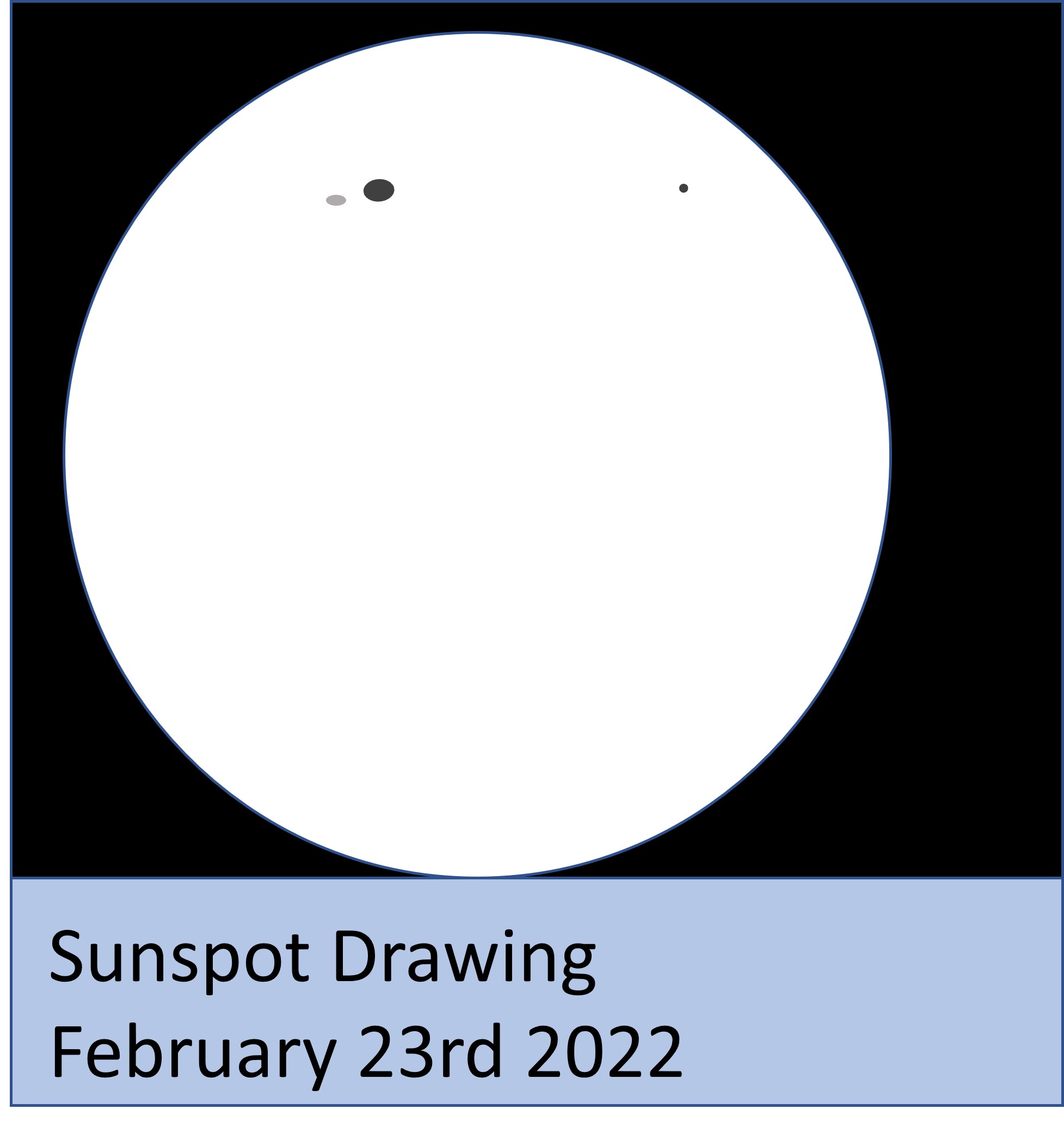
It was not perfectly clear but I was able to see the sunspot pair I had seen 3 days before plus the small, faint one that I missed.


February 22nd 1850 GMT Moon 


The Moon was approaching full phase and it appeared very bright. For once, the Corsham microclimate had worked in my favour! I ended up photographing it with a very short exposure of 1/2000 second. I used 300mm focal length and ISO 100.


I made an audacious attempt to photograph Jupiter's moons handheld at 300mm focal length, ISO 6400 and 1/25 second exposure. I had managed to get it to work before and, although some images showed a nice, round Jupiter, I could not find any moons, despite my digital wizardry.

I then used my phone camera to attempt to capture the Moon and Jupiter at a very widefield setting. I moved to 1.0 zoom and snapped the Moon with Sirius and Procyon.


Although not really within the spirit of using just a phone camera, I superimposed the photo of the Moon taken with my DSLR on both images.


I checked the brightness of Betelguese and it held steady at magnitude 0.6, the same as my previous estimate.

February 20th 1220 GMT Sun


Was it really a whole week since I had seen the Sun? With the 2023 weather persisting into late February, maybe it was no surprise! Fortunately, despite hazy conditions, I was able to see two large sunspots, although I did not see a slightly smaller one that was visible in the professional observatory images.


February 18th 2010 GMT Moon 


Conditions were very similar to the evening before. I discovered why my last Moon photos were overexposed. 


February 16th 2335 GMT Moon 


The sky cleared unexpectedly. The Moon was low in the west. I tried several shots with my DSLR at 300mm focal length. ISO 100 and various exposures down to 1/1000 second.


I also saw Betelguese in the west and estimated its magnitude at 0.6.

With bright moonlight and some thin cloud, it was not a night for deep sky photography. I had a binocular scan around the sky. The Hyades were close to the Moon but I could still see most of the brighter members of the cluster. The Pleiades were very close to the Moon and I could only see six of their stars. Melotte 20, one of my favourite star clusters, stood out quite well but I could not see M35. Moving east, I saw Melotte 111, the large star cluster between Leo and Bootes. I also saw the Beehive cluster in Cancer. Although it's stars were faint, under the conditions, the amazing pattern was still visible. I saw the double star Mizar/Alcor in the Plough. I saw the bright star Vega low in the east. The nearby double star Epsilon Lyrae split easily.


February 12th 1905 GMT Moon and Jupiter 


I snapped the two objects together with my phone camera.


I composed the above image with separate ones of Jupiter and its moons and the Moon to obtain this composite image,


February 12th 2045 GMT Jupiter and Pleiades 


Conditions were a bit worse than the evening before. I set my DSLR camera at 300mm focal length, ISO 6400 and 2 seconds exposure.


I tried for Jupiter's moons and then the Pleiades.


February 12th 1730 GMT Moon

The Moon, as the day before, was at a thin crescent phase but had grown a bit and I was able to photograph more details. I used my DSLR at 300mm focal length, ISO 100 and 1/250 second exposure.


February 12th 1200 GMT Sun


Had I been at home, I would have taken my Mak out for a detailed image. I had my binoculars and filters at work with me and that gave me a chance to get something out of the clear day. I saw some sunspots and drew them, as one does.


February 11th 1930 GMT Photo Session 


It was not clear enough to photograph some faint constellations I was hoping to. I did some close-ups instead. Most photos were taken at 300mm focal length, ISO 6400 and 2 seconds exposure.


First up was Jupiter, in an attempt to capture its moons.


I then photographed Orion's belt.


Next was the Great Nebula.


 I then photographed Mizar and Alcor but it didn't work.

 I changed my settings to 70mm focal length, ISO 6400 and 8 seconds exposure. I photographed the Hyades.


It was very murky near the southern horizon but I decided to try something ambitions and went for the Tau Canis Majoris cluster. I caught some stars in that part of the sky but couldn't say I nailed the shot.


February 11th 1730 GMT Moon 


The thin crescent Moon hung low in the west. I snapped it with my DSLR camera at 300mm focal length, ISO 100 and 1/200 second exposure. I had stopped doing frequent DSLR-only shots but the lack of recent astronomical activity and a thin crescent Moon persuaded me otherwise.


February 10th 0945 GMT Sun


It had been 8 days of continuous cloud and rain. I was starting to think I would fail to get a single decent image in the whole month. The cloud was still there but thinned enough to let me see some sunspots through my binoculars and filters. It was a large sunspot group, with three large and two small ones. After a frustrating week and a bit, it was amazing to see something at last!


February 1st 1910 GMT Jupiter 


Again, the weather forecasters let me down. I was hoping to try out my new camera, the same model as my older one, which was still working but with poor focus. 


I set my camera at 300mm focal length, ISO 6400 and 2 seconds exposure, my usual settings for Jupiter's moons. Initial indications were less than encouraging. 

With a bit of processing, I managed to show the moons but much haze still remained.


February 1st 1215 GMT Sun


The weather forecast was for clear sky but it did not mention some thin cloud. So, despite some sunspots being visible on the professional observatory images, they did not make it through to my binoculars and filters. I was also reluctant to try photographing the Sun, due to cloud ruining my previous attempt.

Sunday, December 31, 2023

January 2024

January 28th 1050 GMT Sun 


There was a lot of thin cloud around, with some patches of blue sky. For a change, especially as it was a weekend, I photographed the Sun with my Mak and DSLR at 1.54m focal length, ISO 100 and 1/500 second exposure.


Although the image captured some sunspots, the cloud ruined the result. 


January 26th 2000 GMT Moon 


It had seemed decades since I had attempted a moon shot with my telescope. Conditions were far from perfect, with lots of moving cloud. I took some shots at 1.54m focal length, ISO 100 and 1/500 second exposure.


January 24th 2100 GMT Moon and Jupiter's moons 


Had it been a normal Wednesday evening, I might have ventured out with my telescope but I had an early meeting the next day.


I tried to use manual and live view focus to try to get Jupiter's moons. I used 300mm focal length, ISO 6400 and a second exposure. I did not use my usual exposure time of 2 seconds, due to moonlight. Although the shot worked, I only caught one moon.


I changed the ISO setting down to 100 and the exposure to 1/1000 second to try to capture the Moon.


January 24th 1900 GMT Moon and Stars


There was moonlight being scattered by cloud and not much was visible.


The Moon and Jupiter were too far apart in the sky to photograph, even with my phone camera totally zoomed out.


I tried photographing the Moon with the bright stars Sirius and then Capella.


January 22nd 2150 GMT Moon and Jupiter 


It was nor quite clear, with most objects looking somewhat hazy. I snapped the Moon and Jupiter with my phone camera.


January 18th 1700 GMT Moon and Jupiter 


Aside from the cold and rapidly falling temperature,  I wanted to catch the Moon and Jupiter when they were very close. I caught them together at 300mm focal length and tried various combinations of settings to catch features on the Moon and Jupiter's moons, although the sky was too bright to guarantee success. Unfortunately, nothing worked.

January 18th 1210 GMT Sun


The lunchtime sky was clear, enabling me to see three sunspots with my binoculars and filters. They had moved since my previous viewing three days before.


January 17th 1930 GMT Moon and Jupiter 


Conditions were clearer than the evening before. The Moon was much closer to Jupiter. I photographed them first with my phone camera then with my DSLR at 70mm focal length at various settings  I then zoomed in to 300mm focal length, again using various settings to photograph the Moon separately and even tried Jupiter's moons hand-held, something I had done only once before successfully. 

When processing I got off to a bad start as the phone camera shot was blurred and Jupiter appeared as a curve.

I had more luck with the DSLR shot of them together.


There was just a hint of cloud belts om Jupiter.


Unfortunately, neither the ,moon shots nor those of Jupiter's moons worked.


January 16th 1725 GMT Moon and Jupiter 


After a cloudy lunchtime and cloudier afternoon, there was some clear sky at dusk.

I snapped the Moon and Jupiter with my camera phone then followed up with my DSLR.


I did not manage to catch the close alignment on my DSLR but I caught the Moon and Jupiter separately and overlaid them onto the above photo to create a composite image.


January 16th 1910 GMT Binocular Session 

After darkness fell, there was quite a lot of cloud around. The Moon was bright and showed a few craters near the terminator. Jupiter showed one moon clearly and a hint of a second.

I could make out the Orion Great Nebula (M42) but only just. The Hyades showed quite well, although I had to move the binoculars round in order to see all of them. The Pleaides (M45) showed only about 20 stars and Melotte 20 in Perseus was also rather sparse in appearance. The other deep sky objects were clouded out.      


January 15th 2150 GMT Phone Camera Shoot


It was not perfectly clear but I tried fiddling about with my phone camera settings, setting the ISO to 800 and increasing the sensitivity to +2EV. I aimed at Orion and Sirius.


I was lucky to catch a meteor, brighter than Sirius flash from the horizon through Canis Minor. It was a great sight and one of the things that make astronomy interesting.


January 15th 1200 GMT Sun


The midday sun was in a clearer patch of sky than the day before. A binocular scan revealed 4 sunspots, two more than the day before.


January 14th 1045 GMT Sun


I bin scanned the Sun through cloud. I was somewhat disappointed not to see more sunspots, as there were some on the professional observatory images. The interesting thing is that the large sunspot I had seen three days before, had split into two, a phenomenon that is not unknown. The Sun is a strange place indeed.


January 13th Astronomical Mug

I found some old photos of a mug I had made at a team building event at work. Unfortunately, it was broken but the intended targets were Orion and the Pleiades (Seven Sisters). Not my best images of either object but a unique take on them.


January 11th 1220 GMT Sun


By the standards of the autumn and the turn of the new year, a minor miracle happened! Although there was plenty of cloud around, not unknown in January in England, I had a clear view of the Sun through my binoculars and filters. The two sunspots I had seen the day before had rotated. The larger one was showing better, as it moved away from the edge of the solar disc.


January 10th 2050 GMT Constellations

The sky was clear, well. to start with! My intention was to capture Orion and the surrounding region, then Camelopardalis. Needless to say, it did not go to plan when cloud moved in from the east.

Instead, I took a few frames of Cassiopeia at 18mm focal length, ISO 1600 and 30 seconds exposure. I also took some dark frames. I stacked using Sequator and finished in GIMP. Not only does the  photo show the Milky Way but also the Perseus Double Cluster and the Andromeda Galaxy (M31).


January 10th 1230 GMT Sun


I had a rare patch of clear sky. A new, larger sunspot had rotated onto the solar disc to join the one I had spotted the day before.


January 9th 2055 GMT Orion and Betelguese 


I tried fiddling with my phone camera to photograph Orion but failed.
 
I retried with the camera default settings which was better. I took ten frames with the hope of stacking. I did not get the stack to work and processed a single frame.


I estimated that Betelguese had faded to about magnitude 0.4.


January 9th 1215 GMT Sun


My binoculars and filters revealed a single sunspot, although there were many fainter ones on the GONG website.


January 6th 2050 GMT Binocular Session 


It was my first night-time binocular session of the year. Conditions were somewhat hazy, dissuading me from any photography.


Jupiter was high in the south. I could see a Moon on each side. 


The Pleiades (M45) were disappointing, showing a maximum of 20 stars. The Hyades all showed, as the main cluster members are quite bight. I cannot get the whole cluster in my field of view, so had to scan round the area to see each star. 


The Orion Great Nebula (M42) showed surprisingly well,  given that the Pleiades didn't. However, I could not make out M35, the star cluster in Gemini.


Melotte 20 showed its main stars but was probably in an area of haze.


January 6th 0115 GMT Betelguese 


Conditions were cloudy and hazy but some stars were visible. I could not see the Pleiades but Betelguese and the nearby bright stars were clear. Possibly Betelguese may have faded a bit but I thought its brightness was nearer magnitude 0.4 than 0.5.

January 5th 1215 GMT Sun


The pale winter Sun hung low in the south. My binoculars revealed four sunspots but the professional observatories showed several more that might have been visible in my telescope or from the southern hemisphere, where the Sun is higher in the sky this time of year.


January 5th 0650 GMT Moon and Venus 


The Moon had rotated closer to Venus in the dawn sky than the previous morning. I snapped them with my phone camera.


January 4th 0720 GMT Moon and Venus 


The Moon was approaching Venus in the dawn sky and was within range of my phone camera.


January 3rd 2040 GMT Betelguese 


I had a quick look outside to see if the sky was clear. Unfortunately, the most interesting part of sky from the Pole Star down towards the horizon was cloudy, preventing me from seeing any Quadrantid meteors. There was a bit of clear sky to the south east long enough to check out Betelguese. Its brightness had appeared steady at magnitude 0.4.


January 2nd 1350 GMT Sun


After a very wet evening, night and morning, it unexpectedly cleared enough to see our nearest and dearest star. Seeing the Sun again was like seeing an old friend I hadn’t seen for years. I saw just two small sunspots but, with such a poor December, it felt like a victory, although maybe a small one.


January 1st 0210 GMT Moon and Regulus


An hour after my Moon shot, it cleared a bit more and I saw it close to Regulus, the brightest star in the constellation of Leo. I snapped it with my phone camera.


January 1st 0110 GMT Moon 


The old year had not long given way to the new. Astronomically speaking, 2023 had been poor, with lots of cloud. 

Rather like the solar session the day before, there was lots of moving cloud. I snapped a few photos of the Moon with my DSLR at 300mm focal length, ISO 100 and 1/320 second exposure. 

Unfortunately, I did not get any useable photos.