Saturday, July 1, 2023

July 2023

July 30th Meteor Reprocess

A planned moon shoot the evening before did not happen and it rained all day. I processed a meteor shot from May 5th 2018. I produced a full frame shot and a close-up.


July 29th 1200 GMT Sun

There were some breaks in the cloud, so I had a look at the Sun with my binoculars and filters. The Sun was a lot quieter, showing just two sunspots, both small.


July 27th Perseid Meteor Reprocess

I reprocessed a shot of a Perseid meteor from August 2017 and produced a full frame and a close-up.


July 27th 1215 GMT Sun


There was some thin cloud around but the Sun showed two large sunspots to my binoculars and filters. It doesn’t sound much but felt great after a few days of persistent rain.


July 22nd Venus with Pollux and Mars reprocess 


I revisited a shot of  Venus with Pollux and Mars from May 10th, taken with my phone camera and cleaned it up using GraXpert and GIMP.

July 21st 2120 GMT meteor hunt


Despite a clear visual view of the Moon there was a lot of haze around. I set my DSLR at 16mm focal length, ISO 6400 and 6 seconds exposure. I aimed eastwards in the area of Perseus and hoped and hoped!

At 2157 GMT I caught something that I could not explain. Probably not little green men but I would like to know what it was.


At 2209 GMT another appeared.


July 21st 2940 GMT Moon 


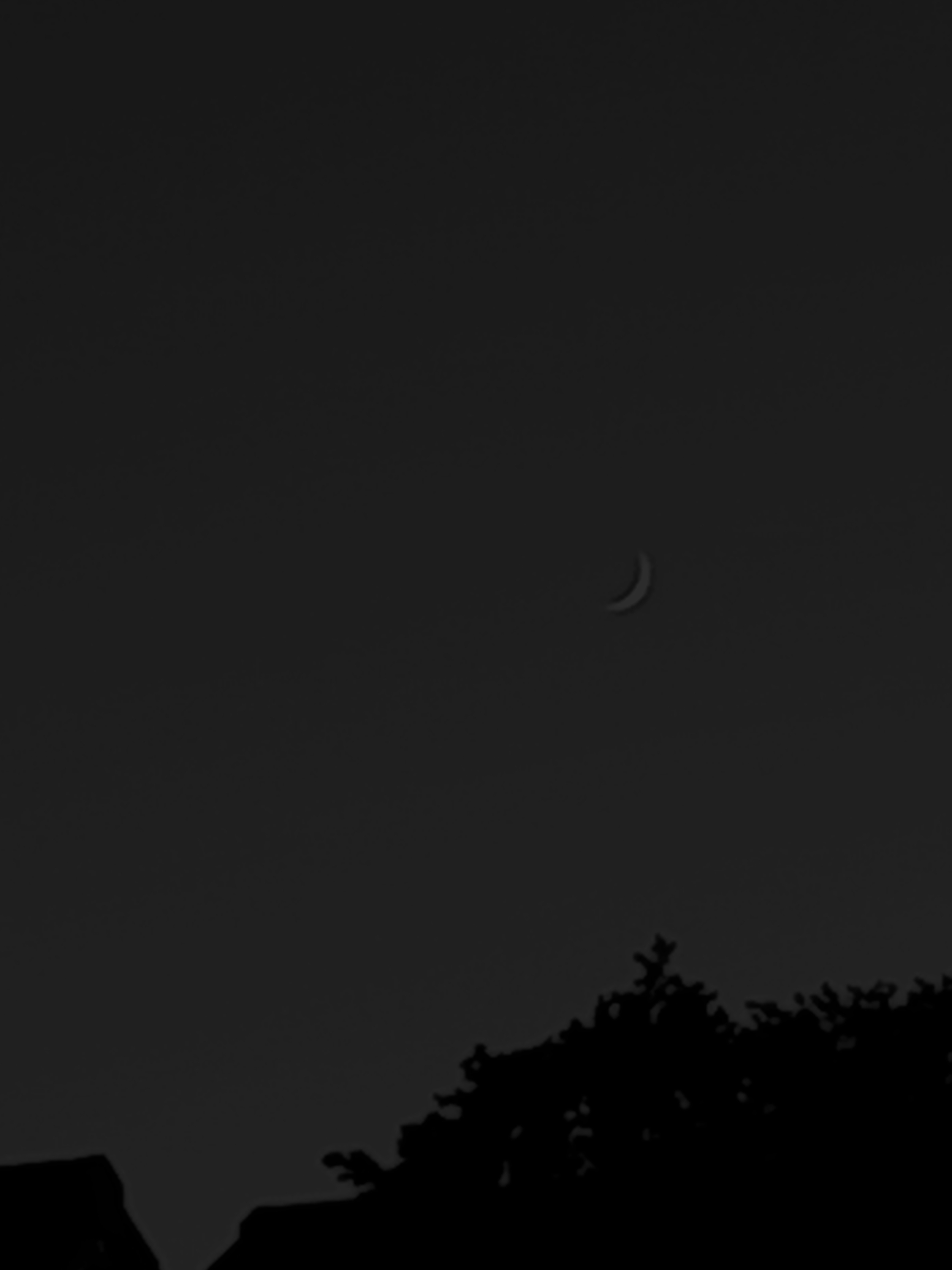
The Moon was low in the west on a hazy sky. I had to walk a few metres south of our front door to see it. It was about four days past new and I took my binoculars out. Mare Crisium was clear of the lunar terminator. Several craters were not just visible but prominent. One was towards the lower right, straddling the boundary between light and dark. I was unable to find its name from the map, though.


July 20th 1145 GMT Sun


I bin scanned the Sun and counted no less than 11 sunspots! This was quite remarkable and showed that, whilst my Mak/DSLR combination was the best for recording sunspots that computer-based drawings could show a lot, too.


July 19th 1200 GMT Sun


There was enough clear sky to see the Sun through my binoculars and filters. Naturally, it would have been better to have my Mak and DSLR at work but I don’t take them. A binocular scan was the next best thing available to me.


July 19th Moon and Venus Reprocessed

I reprocessed a shot of the Moon and Venus from April 25th to clear up the background using GraXpert and GIMP.


July 17th 1150 GMT Sun


There was another rare chance to take a look at the Sun through my binoculars and the sunspot count increased to 7. The original weather forecast had been bad but I decided to bring my binoculars and filters into work. I was not disappointed, at least not for the time being!


July 16th Venus and Jupiter Revisited

With cloud and rain making observations impossible, I revisited another photograph of Venus and Jupiter together on March 7th. I found that using GraXpert to clean up photos taken with a phone camera, I was able to get some half-decent results.


July 15th 1055 GMT Sun

With a bad back and moving cloud, interspersed with rain, I was lucky to see anything at all.

Fortunately, having large (15x70) binoculars and solar filters was more than a great help, revealing no less than 6 sunspots.


July 14th Venus with Jupiter Revisited

I revisited a photo of Venus and Jupiter on February 14th 2023 that I originally took using a phone camera. I was about to use it for a book when I noticed that there was a gradient. Having experimented with GraXpert for constellation photos, I had a go with this one and ended up with quite a clear photo.


July 13th 1140 GMT Sun


There was a brief period of sunshine, during which I could see s sunspot pattern. It was nice to see some activity.


July 11th Aquila Revisited

I reprocessed a more recent shot from July 3rd 2022 that covered Aquila and its surroundings. I had a gradient problem but this time I stacked 10 images using Sequator and processed the result in GIMP, There were still some rough areas around the edges but the final result showed the Milky Way, Delphinus, Sagitta and the Coathanger asterism.


July 10th Cassiopeia Revisited

I reprocessed a shot of Cassiopeia from July 1st 2018 to remove the gradient using GraXpert. Naturally, I did further processing using GIMP.


July 9th 1640 GMT Sun

It would have been great to have photographed the Sun with my Mak and DSLR but my back was too bad to risk carrying them. A view through my binoculars and filters showed two sunspots that I had not seen through the cloud earlier in the day. 


July 9th 0800 GMT Sun

Enough sunlight had made it through the clouds to cast shadows. I checked it out with my binoculars and filters to reveal a single large sunspot. 


July 7th 2110 GMT Venus


Venus was very low in the western sky and I had to walk about a hundred yards from our house to see it. I had a bad back, so snapped it with my DSLR at 300mm focal length, ISO 100 and 1/200 second exposure.


July 7th 1300 GMT Sun


The sky was partly cloudy but I managed to get a large enough gap in the cloud to see the Sun through my binoculars and filters. I was pleasantly surprised to see that new sunspot activity had rotated onto the Sun and another sunspot had darkened enough to reach binocular visibility. This may sound insufficient to excite less astronomically experienced readers of this blog but seeing two new sunspots within 24 hours seems like a dream come true, especially when astronomers remember the last solar minimum, where no sunspots were visible for months on end!


July 6th 1310 GMT Sun

I scanned our nearest and dearest star with my binoculars and filters to reveal three sunspots. After 3 days without any observation nor photos, it was quite welcome!


July 4th Sun Revisited

It was raining so hard that even the water was getting wet. There was only one place where a decent astronomer should be but then I never claimed to be decent. Instead of going down the pub, I reprocessed a solar image from August 27th 2022. Dare I admit to doing anything good? Well this is what happened when I ran a stack and processed the result.


July 2nd 1610 GMT Sun

After a cloudy day, the sky cleared but there was still quite a lot of moving cloud around. A binocular scan showed a single, large sunspot about to rotate off the disc.


July 2nd 2300 GMT Moon

It was the start of the witching hour, that is, if witches observe the changes to daylight savings time. The Moon was almost full and very low in the sky, barely clearing the rooftops and I had to carry my Maksutov and DSLR about 10 yards to get a shot. I suspect that it was south of the ecliptic, making it a very tough object from anywhere north of Liverpool. Usual techniques revealed a moonscape dominated by Tycho's rays.


July 1st 1305 GMT Sun


There was lots of moving cloud around, following a cloudy morning. I bin scanned the Sun with my binoculars and filters, to reveal two sunspots.


Soon after I finally got round to fixing, or trying to fix, my 9x50 finderscope. I had some help from my friendly neighbour, Frank Spencer.

Friday, June 2, 2023

June 2023

June 29th 2000 GMT Moon

 I tried using Pro mode on my phone camera and took some lunar shots in hope. Maybe, just maybe, it was a shade better than my effort on 25th but still no craters.


June 29th 0545 GMT Sun


I had a totally unexpected clear sky! It had been 100% cloud cover and the forecast for the day was far from good. Even better, the Sun did not disappoint. There were what appeared to be two large sunspots but the professional observatory images showed that they were large groups, each with a prominent central spot. Although it was only four days previously, it had seemed a long time since I had seen anything.


June 25th 1935 GMT Moon


I found that there was more I could do in Pro mode than I thought. I also tried shooting a shorter video so I could transfer it to my laptop. I like to try lots of things out. My wife says I am very trying.

The video didn't load into Registax. One of the photos showed some "seas" so must go down as a limited success, although it was worse than my first-ever astronomical photo taken on December 31st 2003, which showed craters.


June 25th 0830 GMT Solar Session 


It was not a good Session, just like the captain of a football team might say when they are 5 nil down at half time!

As Friday, I had trouble finding the Sun but this time trouble extended to complete zilch. The intermittent cloud did not help. A Binocular scan showed that I wasn't missing a lot, as all sunspot activity had faded below Binocular resolution.

A hydrogen alpha session similarly showed a bland, red disc. I took some shots, more in hope than expectancy. I caught some features on camera, though.


June 25th 2345 GMT Visual Session


When astronomers think of summers past, they think of observing in shorts and T-shirts while browsing the delights of the Milky Way and it's surroundings. Chocolate lovers undoubtedly think of Galaxy. That is where I started. The brightest galaxy visible in the northern hemisphere is the Andromeda Grand Design Spiral Galaxy. It was far from its autumn best but its fuzzy shape was like seeing an old friend after many years. 

Being the only galaxy that was realistically visible to my binoculars, I moved on to other objects. The open star cluster Melotte 111 was surprisingly still visible in the west. Moving southwards, the Wild Duck cluster was prominent but looked more like a globular star cluster. With nearby M26 looking fainter, it looked like a smaller, fainter patch of light. The open cluster Melotte 20 showed its main stars, despite almost hugging the horizon.

 On the subject of globular star clusters, through powerful binoculars they look just like a Galaxy. M13 was a neck-breaking view as it was high in the sky. I was able to see M3 and M15. They were lower in the sky but much fainter.

 I did not try to capture the double stars in Draco, as they were almost overhead. The Lyra double stars, Epsilon and Delta were even harder than M13. Alberto in Cygnus, a great colour-contrast double star looked magnificent, as usual. The final double star was the well known Mizar/Accor pair.

I had a browse around the Milky Way and I could see it without binoculars.

The highlight of the session came at 0011 GMT when a very bright meteor appeared west of Lyra and Cygnus and it moved slowly before breaking up near Cassiopeia. Being brighter than Venus, it met the official definition of a fireball.

June 25th 2335 GMT Constellation Shoot


Venus and the Moon had long gone. It was just about as dark as it gets, only 4 days into summer. I set my DSLR at 35mm focal length, ISO 1600 and 15 seconds exposure. I took multiple shots of Cassiopeia and Aquila. A test shot of Sagitta suggested that I might get away with not decreasing the exposure time at 80mm focal length.


At 0011 GMT, I caught a meteor (left) and satellite trail (right) in the same photo! The meteor was probably an Anthelion, which is not a true shower but several meteors are known to originate from a patch of sky opposite the Sun.


At 0019 GMT I caught a meteor trail pass the Coathanger asterism.


My Aquila shot also caught Delphinus.


A second shot showed the Milky Way in the same area of sky.


Not only did my Sagitta shot work but I caught the Coathanger in the top right. It is not a true star cluster, as the stars are all at different distances and not associated with each other.


I reverted to 35mm focal length and aimed at Bootes, hoping to catch a few Bootid meteors. 

At 0113 GMT, I caught a meteor near Arcturus.


I did not manage to photograph Bootes, as it did not fit in the frame but I caught Corona Borealis.


June 24th 2040 GMT Moon and Venus


I took some full disc snaps of the Moon and Venus. My webcam had no charge, so I did some experimental shots with my camera phone with the intention of stacking. The Moon was a bit disappointing, although it showed some surface details.


My disappointment with my Moon photo disappeared when I saw my Venus shots. These shots showed a more realistic view of the phase at about 30%, unlike the 45% that my camera phone suggested.


I was unable to get the videos of the Moon to work because the files sizes were too large. The best of the Moon and Venus shots together worked well, though.


June 23rd 2110 GMT Moon and Venus 

 I did a repeat of the shot the evening before. I was tired and did not want to carry my telescope outside. The only difference was that the separation between them was too great to capture with my longer focal length lens, so I took the shots at 35mm focal length.


I tried to overlay the photos of Venus and the Moon onto the original but it did not work as I hoped. Im preferred the original.


June 23rd 1110 GMT Sun


Do not underestimate the difficulty of finding an object and focussing on it when it is about 60 degrees above the horizon. Add in a lower quality finderscope and broken camera and it becomes much harder! I finally managed to get a few solar images but was dubious about their quality. As it was, the final result was not needle-sharp but showed a lot of detail that I cannot capture in binoculars.


June 22nd 2045 GMT Moon and Venus


There was a patch of clear sky. The Moon and Venus were still quite close in the sky. I caught them with my DSLR at100mm focal length, ISO 100 and 1/200 second exposure. I zoomed in to 300mm focal length to try and catch each object on its own.


The phase of Venus showed as slightly less than 50% but the actual phase was probably somewhat smaller.


I did not nail the Moon shot.

Just after 2100 GMT I could not resist another shot of the Moon and Venus. this time with my phone camera.


.

June 22nd 1735 GMT Sun

Despite seeing many sunspots on the Learmonth images, I only saw the large one from the day before.


June 21st 2105 GMT Moon and Venus 


The Moon and Venus were much closer in the sky. I could not detect the phase of Venus, although the lunar phase showed quite well for a camera phone.


June 21st 1815 GMT Sun

I was expecting to see the same sunspots as before, except that they would have rotated. However, I was disappointed to see just the largest one. Perhaps the sky was not quite as clear as I thought it was. In a difficult month, even a single sunspot counts as a positive. 


June 20th 2110 GMT Moon and Venus


There was very heavy rainfall between my solar viewing and bedtime. I tried some closeup shots of Venus and the Moon using my 'phone camera. I did not catch the phase of Venus at all and the lunar shots showed the phase but no surface detail. The shot showing both worked quite well, given the limited technology.


June 20th  1735 GMT Sun

Wow! Clear sky, at least for a short while and I manged to see some sunspots through my binoculars and filters.


June 18th Lunar Reprocess


It was a cloudy Sunday, so I had another go at reprocessing another lunar close-up.  Despite placing sample points on features and the limb of the lunar disc, I ended up with another fuzzy image.


June 17th Lunar reprocess


I had an awful weekend with lots of cloud. Apart from writing,I decided to experiment with sracking lunar closeups again. I tried aligning on multiple features but this attempt did not work. 


June 16th 1110 GMT Sun


The date brings back many memories for me, relating to fishing. For many years I went fishing and it was fishing that lured me into writing for magazines. Time has moved on and I would say that my time as a fisherman was mostly successful. Whilst, ideally, I would still like to go, the reality is there is only room in my life for one major hobby. So instead of hauling fish out on the first day of the season (I never failed to catch a fish on opening day), I was knocking spots off the Sun.


The Sun was a bit more active than on my previous observation, so I recorded the sunspots I had seen through my binoculars and filters. New hobby, new life, new writing.


June 14th 1200 GMT Sun


I did not habitually carry my Mak and DSLR into work. However, a pair of binoculars and filters was a different matter. It was a way of recording sunspots by my traditional means. I saw three sunspots, which was interesting enough, although showed a quieter sun than the previous few weeks. On the other hand, it was nice to be able to observe anything at all, given the awful winter and early spring viewing conditions we endured in south west England.


June 13th 0610 GMT Sun


Insomnia is a curse. Most of us suffer it at some point in our life and astronomers are no exception. It explains why some of our observations are made and photographs taken at apparently strange times of day or night. I knew that late morning or lunchtime, tiredness would hit me like a sledgehammer but I had been awake for a while and had breakfast and the Sun had cleared the neighbouring rooftops and our fence, ready to full victim to my Mak and DSLR. I got 5 frames ready to stack later and came back inside to start work.


June 9th 1110 GMT Sun


Hay fever or not, I hadn’t had a decent solar photograph all month. I took a series of shots with my Mak and DSLR, with the intention of stacking.


June 8th 2035 GMT Venus 


It was early dusk and Venus was high in the  south west but getting lower in the sky. I snapped it with my DSLR at 300mm focal length, ISO 100 and 1/200 second exposure.


June 8th 1130 GMT Sun


A solar binocular scan showed just a single sunspot, despite there being several on the professional observatory images that were almost as prominent.


June 7th 1210 GMT Sun

After a very cloudy start, only a thin haze was left by lunchtime. I could see two sunspots, one prominent, one faint.


June 4th 1200 GMT Sun 


With bad hay fever and a sore back, I limited my solar activity to a Binocular scan. The two sunspots to the right of the solar disc had rotated off, leaving a single sunspot visible, although there were some fainter ones around below the limits of my binoculars.


June 3rd 1215 GMT Sun


My back and hips were sore after moving the lawn, one of the disadvantages of being in my late 60s. Fortunately, my eyesight was good enough to spot three sunspots through my binoculars, which are much lighter than my telescope.


June 2nd 2130 GMT Moon


The Moon was 2 days before full and very low in the south east. I took some closeups with my webcam, then full disc shots at 1.54m focal length, ISO 100 and 1/500 second exposure.

Unfortunately, the webcam session produced only corrupt files.

Apart from a chunk of the Moon missing, it came out OK.


June 2nd 2030 GMT Venus


I snapped Venus with my DSLR at 300mm focal length, ISO 100 and 1/200 second exposure. I managed to nail the half phase.


June 1st 1949 GMT Moon


I did a visual session on the Moon before sunset. It was low in the south west and a large gibbous phase, nearly full. Despite the daylight, I could see lots of detail. The Ray systems of Tycho, Copernicus and Kepler were very prominent. Plato, the walled plain or lava-flooded crater showed well, with the lunar Alps on show. Linne, a bright crater near Kepler was very bright. I could also see a few small craters near the terminator.


June 1st 1245 GMT Sun


The day started with 100% cloud cover but cleared later, leaving a thin haze. It was transparent enough to see three sunspots through my binoculars and filters.