Thursday, March 4, 2021

March 2021

March 30th 2150 GMT Moon

When we think of astronomy, we imagine crystal clear skies. Reality is often different. A sunny day gave way to a cloudy evening. The Moon was low down and in haze, so I needed to use 1/100 second exposure, instead of the 1/500 second exposure I would have used in better conditions. I was very pleased with the final result, though.


March 29th 2055 GMT Moon

The Moon was low but bright and only just past full. There were many sharp images and it was quite difficult to select the best.shot, a nice problem to have. When I processed the photo in GIMP, I was very pleased with the result.


March 27th 0210 GMT Moon

I did another shoot a few hours later but it was less sharp than the one the evening before.


March 26th 2050 GMT Moon

It was partially cloudy for most of the day. I was hoping to do a telescope shoot but it was not going to happen. I snapped the Moon at 300mm focal length, ISO 100 and 1/640 second exposure.


March 25th 2050 GMT Moon

An attempted lunar shot failed completely.


March 24th 1555 GMT Sun

I tried a solar hydrogen alpha shoot but all photos were ruined by cloud.


March 24th 1550 GMT Moon

With the weather in the evening being uncertain, I shot the Moon with my DSLR at 300mm focal length, ISO 100 and 1/320 second exposure.


March 23rd 2250 GMT Moon

I was overdue for a really good lunar imaging session. I had been pleased with my efforts with my DSLR but had hardly used my telescope all year. The Moon was high in the south west and well-placed from our conservatory to take some images without straining my hips, shoulders or back.

 It was a shame that my Bresser Electronic Eyepiece was functionally challenged, so I decided to do one set of shots with my Mak and DSLR. I took 20 frames at 1.54m focal length, ISO 100 and 1/100 second exposure and stacked the best 18.


I inserted a 3x Barlow lens into the imaging train to boost the focal length to 4.62 metres. I increased the exposure time to 1/10 second. An alternative was to boost the ISO setting. I stacked 19 images taken around Mare Crisium to get this close-up.


I stacked four photos to get this image of some of the southern craters.


Clavius was in this stack of 12 images.


The next stack of 12 images showed Clavius and Tycho.


The next batch of 17 frames revealed Plato.


11 frames showed both Copernicus and Sinus Iridium.


The next 15 frames showed Copernicus in a central position.


The next 23 frames showed another group of southern craters.


Another 23 frames revealed some more craters.


10 more frames showed Copernicus.


The next 15 frames showed another view of Plato.


The final shot with 25 frames shows Plato and Sinus Iridium.


It was not a 100% successful shoot. Some shots worked quite well, others worked but showed little more detail than in the full disc shots. On reflection, I should have used a shorter exposure and higher ISO. We learn to experiment!

March 23rd 1825 GMT Moon

It was early dusk and the Moon was high in the sky.. I snapped it with my DSLR at 300mm focal length, ISO 100 and 1/320 second exposure.


March 22nd 1845 GMT Moon

I tried another set of shots during dusk. I kept the same focal length and exposure settings but reduced the ISO to 100.


March 22nd 1730 GMT Moon

The afternoon before, it was clear, so I thought it would still be clear after sunset. It wasn't and the opportunity was missed. I took no chances and did a shoot before sunset. The moon was just past first quarter but libration made Clavius stand out clearly. It was also nice to see Tycho without its rays.I used my DSLR at 300mm focal length, ISO 400 and 1/320 second exposure.


March 20th 2215 GMT Moon

Most of the sky was covered by various thicknesses of cloud. The Moon appeared to be in a clear patch of sky, so I had another go with the same settings.


March 20th 1955 GMT Moon

It was clearer a bit later but there was some thin cloud around. I tried the same settings as before and got a reasonable result.


March 20th 1845 GMT Moon

Conditions were poor but I had a go at the Moon with my DSLR at 300mm focal length, ISO 100 and 1/250 second exposure. No shots worked.

March 17th 2145 GMT Moon

I snapped the Moon with my DSLR at 300mm focal length, ISO 100 and 1/250 second exposure.


I switched lenses and settings to 18mm focal length, ISO6400 and 6 seconds exposure, or I thought I did. The first test shot showed that I had forgotten to set the ISO correctly. The second was more successful, showing Orion, Taurus and Canis Minor.


I stacked 15 of 18 images to get this snap of Gemini.


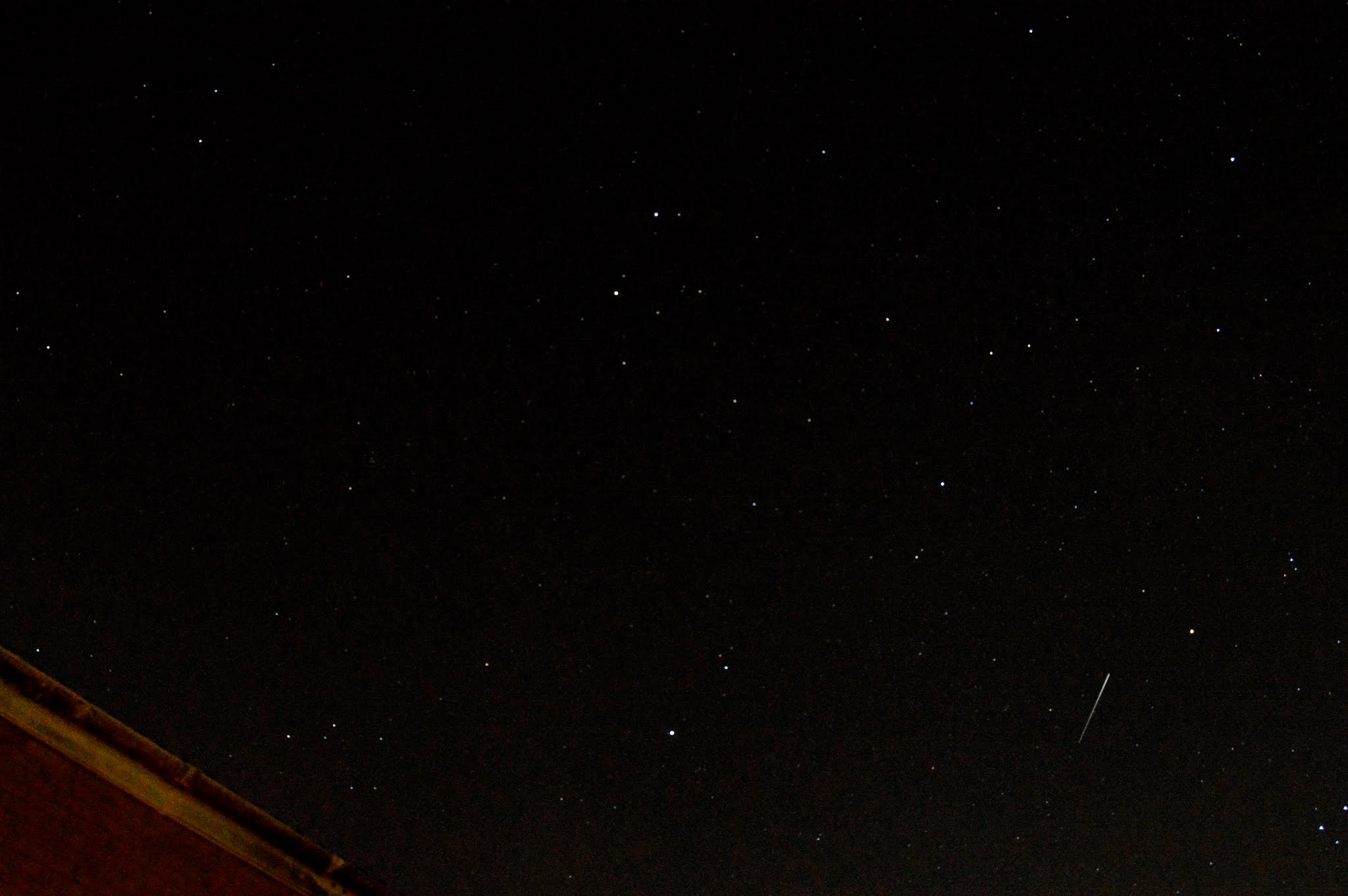
At 2012 GMT, I caught a meteor near Gemini that appeared to come from the direction of Canis Minor.


March 16th 2230 GMT Binocular Tour


I could not remember the last time I was able to do this. Conditions were not perfect, especially near the horizon but I saw some nice sights. This session overlapped with the previous one, as my camera was happily gathering photons. Firstly, I estimated Betelguese to be about magnitude 0.7, a small fade and closer to Aldebaran in brightness.


My 15x70 binoculars showed the Orion Great Nebula (M42). The Pleaides (M45) showed about 30 stars, a bit less than the 40 to 70 I usually see. The best sight was the Beehive (M44) riding high in the south. I was also able to capture the star cluster M35 in Gemini. The Leo galaxies M65 and M66 did not show and I could just make out a fuzzy path where the galaxy M81 in Ursa Major should be. The Andromeda Galaxy (M31) was above the horizon but it was low down in the murk.

March 16th 2130 GMT Meteor Scan

I set my camera up to catch meteors using my DSLR and intervalometer to take 6 second exposures at 18mm focal length, ISO 6400, as usual.

I started off doing a test shot of Gemini.


Unfortunately, I did not catch any meteors and the sky background overhead was not interesting.

March 16th 2100 GMT Deep Sky

Unlike the night before, it stayed clear after it became dark and the Moon was setting, as I performed a deep sky shoot. I started with my DSLR at 300mm focal length, ISO 6400 and 2 seconds exposure. It did not go to plan! On my first set of frames on the Pleaides (M45), I had problems with camera shake, despite using shutter remote control. I reduced the exposure to 1 second then tried to stack multiple images but Deep Sky Stacker wasn't co-operating. Despite my difficulties, I ended up with a passable result from a single frame.


Early in the session (2107 GMT), I saw a bright meteor that easily outshone Sirius but, at about magnitude -2, it was not bright enough to call a fireball. Still, it bright, red trail was a fine sight. Ironically, had I not been deep sky shooting, there was a more than even chance, I could have caught it in a meteor search.

I managed 3 reasonable frames of the Orion Great Nebula (M42) and they stacked well.


 I changed to 70mm focal length, ISO 6400 and 6 seconds exposure. My first set of shots were of Orion's Belt and M42. It worked but I had taken better, similar shots in the past.


I stacked 10 frames of the Hyades with Mars.


The Mars with the Pleaides (M45) used the same method but produced a better result.


I tried to catch M35 but missed it.

March 16th 1855 GMT Moon

I repeated the lunar shot from the day before, with the same settings.


March 15th 1855 GMT Moon

I had another go with similar settings as it became darker.


I'm not sure which I prefer. I was hoping for some action in full darkness but it clouded over.

March 15th 1830 GMT Moon

It had been 8 days since my last successful day, with lots of frustration with the weather. I snapped the Moon about 30 hours since the new phase and caught some detail. I used my DSLR at 300mm focal length, ISO 400 and 1/200 second exposure.


March 11th 2040 GMT Meteor Hunt


It was partially clear but cold and windy, so I stayed indoors and let my camera do the work at my usual meteor settings of 18mm focal length, ISO 6400 and 6 seconds exposure. I aimed the camera overhead to avoid clouds and extinction.

However, the photo shoot was a disaster. The shots were all out of focus and the battery ran out after 300 frames.

March 7th 2040 GMT Meteor Hunt


There was no particular reason why any part of the sky should produce more meteors than others, apart from the zenith being better, because there is less atmosphere for the light to pass through. I chose the north east because it was a darker part of sky, with less light pollution. However, I chose the Taurus area to make sure that the focus was not too far out.

I caught a short meteor trail at 2053 GMT.


I never caught any more but I stacked 7 of 25 images to get this shot of the Plough and Ursa Minor.


March 1st 1930 GMT Betelguese and Meteors

Although conventional wisdom suggests that photographic magnitude is different to visual magnitude, my test shot was aimed at Orion and also caught the main comparison stars of Procyon and Aldebaran. It suggests that Betelguese was about magnitude 0.6, which is what my parallel visual observations made it. Rigel seemed only slightly brighter than Betelguese but this is normal from the northern hemisphere. I have seen both stars emerge from the twilight from the southern hemisphere and Rigel always appears first.


There was no particular reason why I should have aimed at one part of the sky rather than another, so I aimed ar the Perseus/Auriga region, hoping for some nice shots of constellations. I stacked 4 of 20 images to get this.


I did not catch any meteors.

Thursday, February 4, 2021

February 2021

February 28th 2210 GMT Moon

Moonlight had just about ruined any chance of catching anything fainter than Venus, apart from the Moon itself. So DSLR at 300mm focal length, ISO 100 and 1/800 second exposure.


February 28th 1930 GMT Meteor Hunt

I started with a test shot of Orion and Taurus and it seemed fine. However, there was a large blur on the image, as the lens needed cleaning, Naturally, I did not find out until processing time! At least I caught Taurus with Mars as a guest "star".


Unfortunately, I did not detect any meteors.

February 27th 2010 GMT Moon and Betelguese

I snapped the full moon with my DSLR at 300mm focal length, ISO 100 and 1/1000 second exposure.


I also checked Betelguese and confirmed earlier observations that it was magnitude 0.6.

February 26th 2030 GMT Moon

I snapped the full moon with my DSLR at 300mm focal length, ISO 100 and 1/1000 second exposure.


February 26th 1500 GMT Sun

I photographed the Sun in hydrogen alpha light using my PST and DSLR used afocally on automatic settings. However, the result was somewhat underwhelming.


February 26th 1215 GMT Sun

David Blanchflower posted an amateur photo showing sunspots. Naturally, I had a go and I took one with my DSLR and filter at 300mm focal length, ISO 100 and 1/4000 second exposure.

I did not catch any sunspots but my result shows limb darkening, where the central part of the Sun is brighter than the edges.


February 25th 2000 GMT Moon and Betelguese

Another turn in the twist of the tale saw Betelguese "brighten" to magnitude 0.6. I doubt whether it had faded rapidly and re-brightened. It was more likely that my estimate of February 22nd was in error. As for the Moon, I used a similar set-up to 22nd but used an exposure time of 1/800 second.


February 22nd 2000 GMT Moon and Betelguese


Betelguese has a nominal period of 332 days but it had faded noticeably since I last saw it. It was nowhere near as bright as Procyon and only a bit brighter than Aldebaran. My estimate was magnitude 0.7.


I snapped the Moon with my DSLR at 300mm focal length, ISO 100 and 1/400 second exposure.


February 18th 1835 GMT Moon

After a rainy day, I snapped the Moon with my DSLR at 300mm focal length, ISO 100 and 1/320 second exposure.


I also checked Betelguese at magnitude 0.6. No change.

February 16th 2150 GMT Deep Sky and Betelguese

The Moon had almost set and its influence on the rest of the sky had diminished. Firstly, I checked Betelguese. The main comparison stars when it is around the middle of its range are Procyon and Aldebaran, and these were almost the same elevation above the horizon as each other and Betelguese. Unlike previous evenings, Betelguese was noticeably fainter than Procyon but still brighter than Aldebaran. This observation suggested a fade to magnitude 0.6.

I set my DSLR at 70mm focal length, ISO 6400 and 6 seconds exposure for some deep sky photography. First up was the Orion Great Nebula (M42), also showing Orion's Belt.


Next was the Hyades.


Finally, the Pleaides (M45) composed of 4 stacked photos and finished in GIMP.


February 16th 1810 GMT Moon

Fortunately, the sky was much clearer than the evening before. Although the photo was not perfect, I caught a reasonable shot of the Moon at 300mm focal length, ISO 100 and 1/200 second exposure.


February 15th 1810 GMT Moon

Conditions were quite poor, with the Moon looking blurry and no stars were visible. I managed to get a few images, the best being at 300mm focal length, ISO 100 and 1/25 second exposure. However, the result was still blurry, although some details were present, notably Mare Crisium.


February 10th 2100 GMT Constellations

I had a bit of clear sky for a change. Had Betelguese reached the same brightness as Procyon? It is difficult to tell when stars are of different colours, so I would err on the cautious side and say that it was the same magnitude as the evening before: 0.45/

What a time for my intervalometer to stop working! I've replaced two of them and they seem to fail every year or two. I considered that I could try again in daylight sometime.

Fortunately, I caught Perseus in the centre of the frame, using my normal meteor settings. ISO 800 and 30 seconds exposure might have been better but it was cold. I was pleased with the final result, which also showed the Pleaides and the W of Cassiopeia.


I took another set of frames centred on Orion and bagged the shot I was attempting the evening before. This time I stacked three of five frames and also caught the Hyades and Pleaides.


February 9th 2230 GMT Meteor Hunt

A later session also failed to produce any meteor trails. Part of an image stack was ruined by cloud but part of it showed a nice widefield Hyades and Pleiades.


February 9th 2210 GMT Meteor Hunt

My initial attempts to catch constellations and meteors to the west failed, so I switched my attention to the north. I stacked five images to show Cassiopeia, Ursa Minor and part of Perseus.


February 9th 2200 GMT Betelguese

There was a clear patch of sky to the south west. I compared Betelguese to the nearby stars and it outshone Aldebaran and Pollux by a fair margin. It was still fainter than Procyon but not by much. I estimated its brightness at 0.45, which many say is brighter than its "normal" range of 0.5 to 0.9. I have recorded it as equal to Rigel at times in the past.

February 4th 0715 GMT Moon

The Moon was behind moving cloud, so I did not have much time. I managed to catch the last quarter phase at 300mm focal length, ISO 100 and 1/250 second exposure.


February 3rd 2040 GMT Meteor Search

The sky around Taurus had patchy cloud, so I resumed operations in the direction of the Plough. I did not capture any meteors but I processed four frames to obtain a widefield view.


February 3rd 1915 GMT Meteor Search


I cannot remember the last time I had a clearish night with no moon. I aimed my camera at Taurus, set at 18mm focal length, ISO6400 and 6 seconds exposure. I used my intervalometer to take repeat frames.

I stacked the best 5 frames of the first 10 to obtain a constellation shot of Taurus and Auriga.


I was not completely happy with my first shot, so I had go at stacking a later set of frames.


I caught a meteor at 2054 GMT. Looking at the photo and the relative brightness of Auriga, it appeared to be magnitude -7 or brighter!


MORE TO COME ...