Wednesday, September 2, 2020

September 2020

September 27th 2020 GMT Moon and Jupiter’s moons


Conditions were a bit hazy, despite a clear day. I had trouble focussing on the Moon, with my settings on 300mm focal length, ISO 100 and 1/500 second exposure.


I used my usual settings for Jupiter’s moons: 300mm focal length, ISO 6400 and 2 seconds exposure.


September 25th 2040 GMT Lunar and Planetary Close-Ups

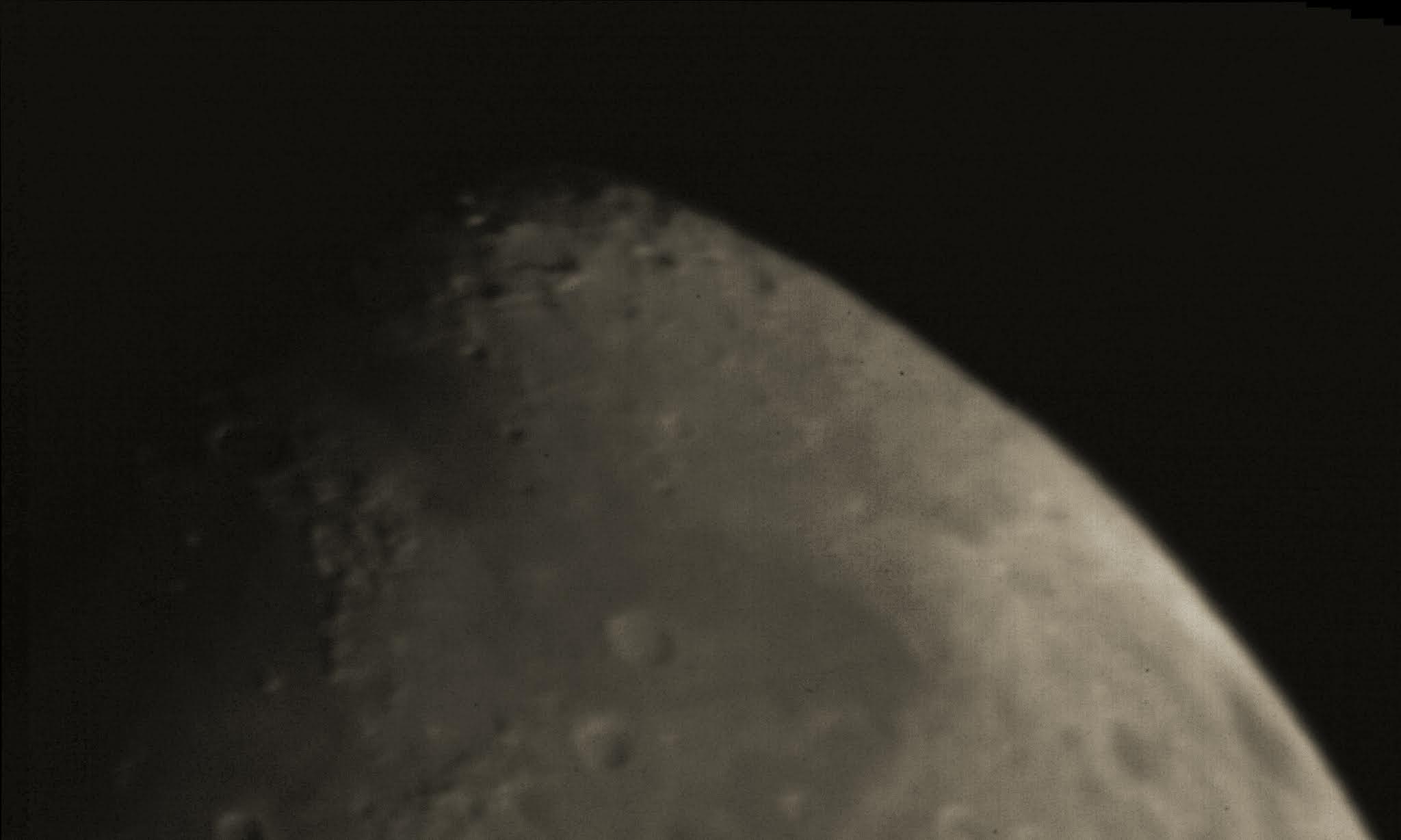
I took my Mak out with my DSLR to do some lunar close-ups. I used a Barlow lens to reach 4.62 metres focal length, ISO 100 and various exposures from 1/100 second to 1/10 second. Although I was able to show a lot of detail, the focus was not quite spot-on.


The focus was way out on the Jupiter shots.

I caught Saturn's rings but it was hardly a classic.


I caught some shading on Mars but, like the Saturn shot, was hardly memorable.


I took some widefield shots of the Pleaides (M45), The images did not stack so I processed a single frame.


Unlike the Pleaides, I got 9 shots of the Hyades to stack.


September 25th 2000 GMT Moon, Jupiter and Saturn


I had hoped to catch all three objects the evening before but it was clouded out. If anything, the night of 25th, they were closer, with the Moon particularly close to Saturn.


I started off with the Moon at 300mm focal length, ISO 100 and 1/400 second exposure.


I was not fully sure of the focal length but I fitted all three into the camera field of view at ISO 6400 and 1/50 second exposure.


Time for some digital wizardry! I brightened Saturn to make it more visible. I also resized my Moon shot and overlaid it onto the above image to counter the over-exposure.


I then took some frames of Jupiter at 300mm focal length, ISO 6400 and 2 seconds exposure.


You can probably guess the next bit. Of course I superimposed Jupiter with its moons onto the original image.



I repeated the same with Saturn, although I did not expect anything in the moonlight glare.


I didn't capture any saturnian moons but superimposed the Saturn image onto the conjunction photo to finish off.


September 24th 2300 GMT Mars


I took several frames of Mars with my Mak and DSLR at 1.54 and 4.62 metres focal length. I used ISO 100 and varied the exposure between 1/40 and 1/100 second. This was the best but, honestly, I was underwhelmed, with the focus out in all images.


September 23rd 2015 GMT Meteor Hunt


I set a meteor trap aimed near the Summer Triangle. I had failed with a similar attempt the evening before and wanted another go, so set the focus carefully.

At 2025 GMT I caught a meteor travelling north west from Cygnus.


I also processed some frames as by-products to obtain yet another Cygnus/Lyra photo.


September 20th 2100 GMT Jupiter’s moons


Jupiter was low in the west. I took some shots at 300mm focal length, ISO 6400 and 2 seconds exposure.


September 20th 1820 GMT Moon

The thin crescent moon was low in the west. I took some frames with my DSLR at 300mm focal length, ISO 100 and 1/100 second exposure.


Unfortunately, my focus was poor (well it IS hard to focus on a thin crescent).


September 19th 2200 GMT Mars


Despite mowing 2 patches of dandelions, clover and moss the day before, my back had recovered enough to use my largest telescope, my 127mm Maksutov. My original intention was to look at Mars, which I had not since it came into the evening sky. Mars is a difficult object at the best of times and there was a clearish patch of sky above our house. Jupiter and Saturn were obscured by clouds and, for much of the time, Mars was the only object visible in the sky.


With it being a favourable opposition in October, the martian disc was surprisingly large and showed a lot of albedo features across its centre. This was despite using a magnification of 64x, quite low for Mars. I swapped eyepieces to deliver a magnification of 103x. This made the detail more clear and the polar ice cap flickered in and out of view. I added a Barlow lens (2x) to produce a magnification of 206x. Many nights I had found this to be the optimum but this night it resulted in a fuzzy image that was bouncing around in the eyepiece.


I placed the original eyepiece back, in conjunction with the Barlow lens, to produce a magnification of 128x. It was great! The albedo feature seemed to have at least two branches and the ice cap was a clear semicircle.


Although my primary intention was visual, I could not resist the temptation to photograph the planet through the eyepiece. The photo did not capture the ice cap but otherwise was a good representation of what I saw.


I also took some frames with my DSLR at 1.54 metres ISO 400 and 1/50 second exposure. I did not have time to increase the focal length before cloud rolled in. Unfortunately, I did not register an image,

September 17th 2055 GMT Meteors

It was a clear night. Unfortunately, I was busy with non-astronomical activities, so I left a camera outside using my normal meteor detection technique. I aimed at Cassiopeia, as there were some minor showers active in that area.

I picked up something at 2211 GMT to the west of Perseus. I originally thought it was a satellite trail but I did not see it on any frames before or after I detected it, so it was probably a meteor.


I also caught a "guest star" in Perseus, not far from Alpha Persei. It may well also have been a meteor, as it was not visible on any surrounding frames.


At 2240 GMT, I caught a nice meteor, possible a member of a minor shower.


As usual, I processed some frames as by-products to obtain constellation shots. I stacked 20 early frames to catch Cassiopeia and some surrounding stars.I was also pleased to catch some deep sky objects, notably the Andromeda Galaxy (M31), Perseus Double Cluster and Melotte 20.


I stacked 20 later frames when Perseus had cleared the trees. Although M34 was visible, the photo was spoiled by some condensation on the lens.


September 16th 0510 GMT Moon

The Moon had shrunk to a very thin crescent and I had to up the ISO to 400, as I had difficulty getting anything to register on the camera at all.


September 15th 0505 GMT Moon

The Moon had separated from Venus and had shrunk to a thin crescent. I used the same settings as the morning before but increased the exposure time to 1/100 second.


September 14th 0505 GMT Moon and Venus


The Moon and Venus fitted into the field of view of my DSLR at 300mm focal length, ISO 100 and 1/200 second exposure.


September 12th 2115 GMT Meteors

I wanted to view Mars, with Jupiter and Saturn was secondary targets but I had a bad back. Instead, I hunted for meteors.

I caught one with a short trail at 2328 GMT.


I processed a few frames to catch Cygnus and Lyra but the photo on 5th was much better.


September 11th 2230 GMT Deep Sky and Jupiter


I set my DSLR at 300mm focal length, ISO 6400 and 2 seconds exposure. I captured several frames each of Jupiter, the Pleaides (M45) and Melotte 20.


September 10th 2120 GMT Jupiter’s moons


It was hazy, with a lot of moving cloud but I had a go at Jupiter’s moons using my usual settings.


September 10th 0510 GMT Moon and Venus

It was dawn, so I took shots of the Moon, then Venus with my DSLR at 300mm focal length, ISO 100 and 1/320 second exposure.


The Venusian disc was smaller than the last time I had seen it but the phase was more obviously gibbous.


September 6th 2140 GMT Moons


Conditions were somewhat hazy. I snapped Jupiter’s and Saturn’s moons, or at least tried to.


I then snapped our moon at 300mm focal length, ISO 100 and 1/250 second exposure. Unfortunately, none of the shots produced a result that I could work with.

September 5th 2215 GMT

The purpose of the session was a meteor hunt, as I often do. I did not catch any, using my regular settings of 18mm focal length, ISO 6400 and 6 seconds exposure. However, I stacked 16 images to catch Cygnus, Lyra and the surrounding Milky Way.


September 5th 2140 GMT Moon and Planets

I was still suffering from a bad hip, so did not take any telescopes outside. Instead, I took my camera out.

First up, I aimed at Jupiter and Saturn, in an attempt to capture their moons.


Next was the Moon and Mars.


Then the Moon on its own to capture some detail.


 I had a final pot at Melotte 20. I don't normally do deep sky photography with a bright moon about but 11 frames stacked produced a better result than I would have expected.


September 4th 2250 GMT Moon
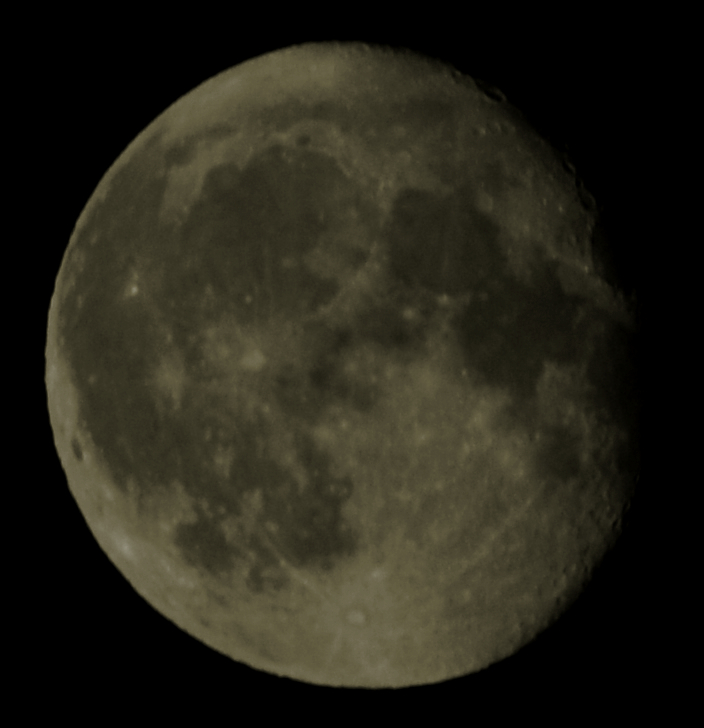
Just before midnight there was some clear sky. The Moon appeared from behind a bank of cloud and I snapped it with my DSLR at 300mm focal length, ISO 100 and 1/500 second exposure.


I also snapped the Moon with Mars.


September 4th 2350 GMT Moon


After a couple of poor days and evenings, I saw a hint of clear sky. Although there was some moving cloud, I snapped the Moon at 300mm focal length and ISO 100. My initial setting of 1/400 second was too bright, so I reduced it, in several steps to 1/640 second.


As Mars was around, I decided to snap Mars, just to see what I could get with a DSLR. As one does!


September 1st 2010 GMT Moon


It was dusk, with the Moon low and light cloud was scattering its light. I used my DSLR at 300mm focal length, ISO 100 and 1/400 second exposure.


I then snapped Jupiter and Saturn together at ISO 6400 and 2 seconds exposure. I was not sure of the exact focal length but it was clear that they were becoming closer in the sky.


As it was still twilight, I did not attempt to capture Saturn’s moons but I had a go at Jupiter’s using my DSLR at 300mm focal length, ISO 6400 and 2 seconds exposure. In retrospect, I should probably used a shorter exposure.


Saturday, August 1, 2020

August 2020

August 30th 2145 GMT Moon

There was a hole in the cloud around the Moon, with it being close to full phase. I shot it with my DSLR at 300mm focal length, ISO 100 and 1/400 second exposure.


August 27th 0510 GMT Venus


Venus was high in the east before sunrise. I snapped it with the same settings that I used for the Moon the evening before. Most of the frames were poor but I had one that was so spot-on that it could have been taken using a telescope.


August 26th 1940 GMT Moon


There was some thin cloud about but I managed a few frames of the Moon at 300mm focal length, ISO 100 and 1/250 second exposure.


August 22nd 1930 GMT Moon

Sometimes, it is not so much a case of carefully planning a shot but grabbing an opportunity on an otherwise blank day. I caught the Moon through a gap in the cloud. I used my DSLR at 300mm focal length, ISO 100 and 1/125 second exposure.


August 20th 2145 GMT Meteor Hunt


Conditions were still poor but I aimed my camera in the area of Cassiopeia in the hope of catching some Perseid meteors. I caught none on camera and had a look for a few minutes at a time but without success. Cloud and poor focus meant that none of the frames were any use for constellation shots.


August 20th 2055 GMT Jupiter and Saturn 

Conditions were quite poor but I managed to catch three of Jupiter's moons.


I caught Jupiter with Saturn but the photo was not as good as the one earlier in the month.


August 18th 2135 GMT Perseid Meteor

This was probably one of the latest days in the year that I saw my first Perseid shower meteor, although I photographed a faint one a few days earlier. Conditions were poor but not completely impossible. There was thick moving cloud but the odd clear patch of about four degrees square at the most. I saw part of a trail of what seemed like a bright meteor. Within five minutes, the cloud gaps disappeared and that was that.

I decided against leaving a camera outside, due to the wet weather.


August 11th 0530 GMT Moon


I snapped the last quarter Moon with my DSLR at 300mm focal length, ISO 400 and 1/250 second exposure.


August 9th 2310 GMT


I had been hoping to catch some Perseid meteors but the sky was becoming lighter, due to the presence of the waning gibbous moon, which was rather bright. I abandoned the meteor hunt and took some snaps of the Moon at 300mm focal length, ISO 100 and 1/500 second exposure.


I then snapped the Moon with Mars at 300mm focal length, ISO 6400 and 1/40 second exposure.


August 8th 2145 GMT Meteors


I set a camera to take automatic repeated shots of the area of Cassiopeia at 18mm focal length, ISO 6400 GMT and 6 seconds exposure. The intended target was the Perseid meteor shower.

I caught a sporadic meteor on camera at 2204 GMT.

I caught a much fainter sporadic meteor at 2217 GMT.

Finally, I stacked 25 early images to obtain a half-decent image of Cassiopeia and Cepheus.


August 8th 2130 GMT Jupiter and Saturn


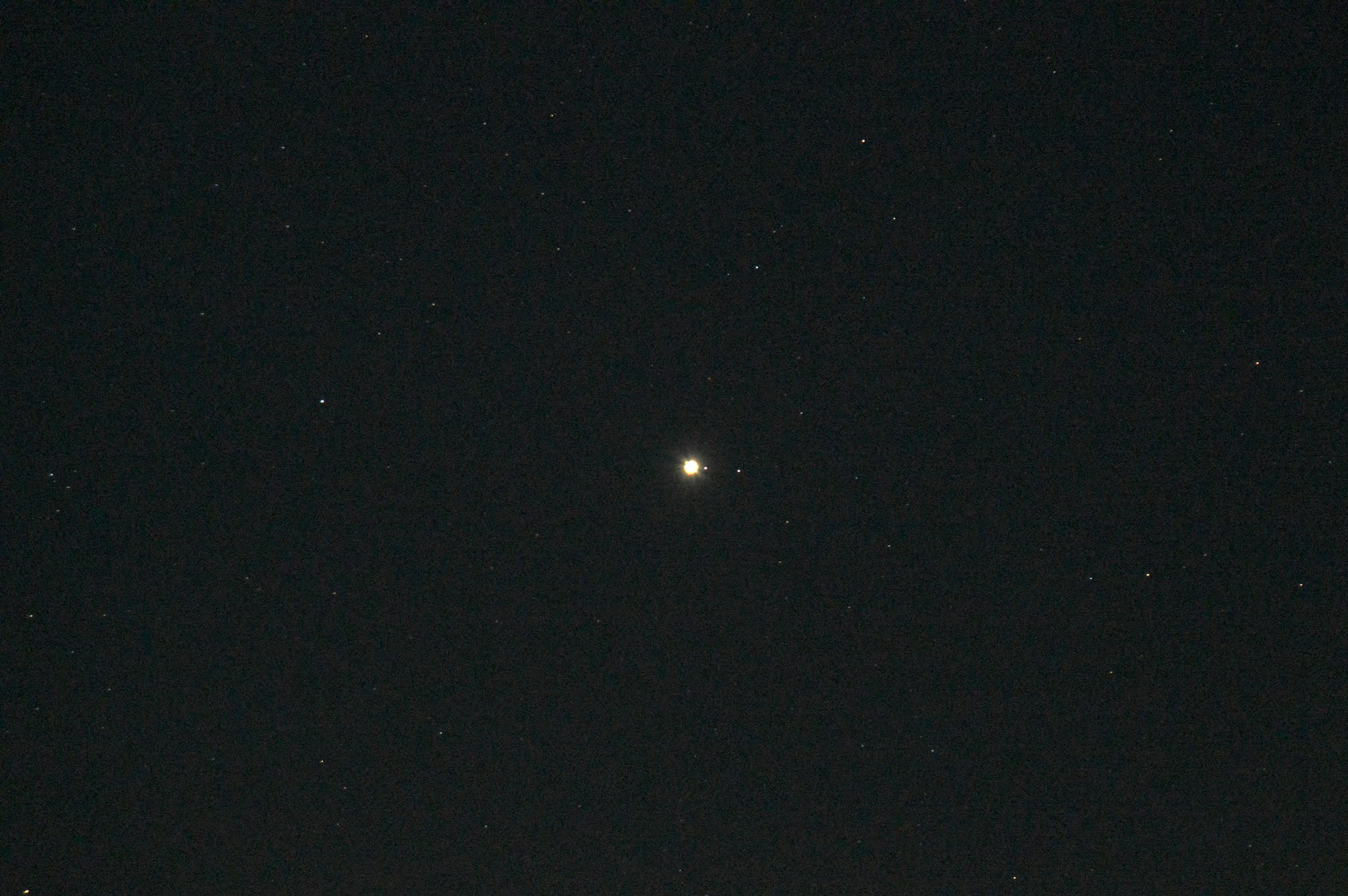
I snapped Jupiter with its moons with my DSLR at 300mm focal length ISO 6400 and 2 seconds exposure.


 I followed up with Jupiter with Saturn at 200mm focal length, ISO 6400 and 3 seconds exposure.


August 8th 0915 GMT Sunspot

I did a sunspot drawing from binocular observations.

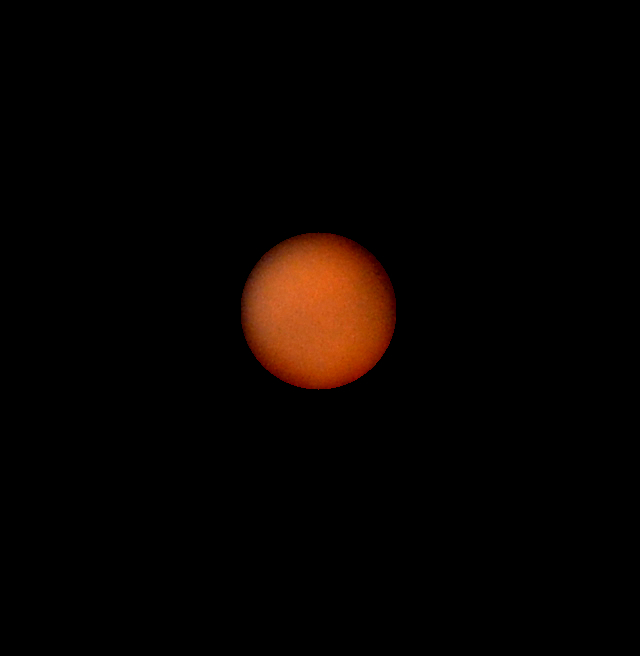
I snapped the Sun with my DSLR at 300mm focal length, ISO 100 and 1/4000 second exposure. Unfortunately, the focus was not spot on, so I did not capture the sunspot.


I then did some afocal shots with my PST and DSLR in an attempt to capture hydrogen alpha features.


August 7th 0530 GMT Moon


The waning gibbous moon was in the south west. I photographed it with my DSLR at 300mm focal length, ISO 400 and 1/500 second exposure.


August 6th 1830 GMT Sun

A sunspot appeared and I did a drawing based on binocular observations.


August 1st 2240 GMT Meteors


I set my camera to take multiple exposures centred on Cassiopeia in an attempt to catch Perseid meteors. I used my usual settings of 18mm focal length, ISO 6400 and 6 seconds exposure. I did not have any luck with meteors but stacked a few images to get a passable Cassiopeia.


August 1st 2235 GMT Moon, Jupiter and Saturn


I tried to photograph Jupiter’s moons but used a shorter exposure as the shot was affected by glare from the Moon.


I then snapped the Moon, Jupiter and Saturn together at 150mm focal length, ISO 6400 and 1/50 second exposure.


I combined this with my Moon shot.


August 1st 2035 GMT Moon and Jupiter


I snapped the Moon at 300mm focal length, ISO 100 and 1/400 second exposure.


As Jupiter was very close, I upped the ISO to 6400 to catch them both together.