February 27th 2115 GMT Deep
Sky
With observations of Venus and the Sun
and a clear sky in the afternoon, I eagerly anticipated nightfall. My hopes
were dashed at 1930 GMT when I could not see a single star.
Fortunately, it cleared later, only for
me to mis-snap the Pleaides (M45), as my zoom lens was set on macro. I reset my
camera but cloud had moved in and it was a case of moving from object to object
until it got too cloudy and cold to continue.
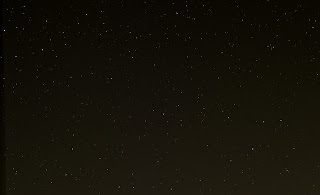
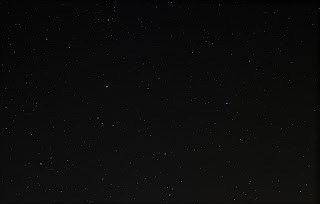
I set my camera at 70mm focal length, ISO
6400 and 8 seconds exposure. I originally intended to take several shots of a
few objects at different focal lengths but went for quantity instead, aiming at
the Hyades, Orion Great Nebula (M42), Beehive (M44), M41 and Melotte 111 on a single setting. At the end of the shoot, I shot 15 dark frames.
I stacked 7 frames of the Hyades and used the master dark frame.
I only had 3 useable frames of the Orion Great Nebula (M42) and cropped a lot of cloud from the fional image.
M41was low in the murk with lots of cloud. I cropped out everything except the cluster and got a result of sorts.
As it is one of my favourite objects, the Beehive (M44) got 15 frames.
I only got one decent shot of Melotte 111, so processed that.
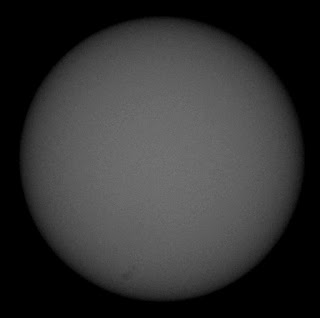
February 27th 1200 GMT Sunspot
It was nice to get some continuous solar
action at the end of the month, although the weather forecast for the next few
days (at the time of writing) meant that I expected to be processing and
blogging for most of the next week.

February 27th 0555 GMT Venus
I snapped Venus, which appeared to be
brightening in the dawn sky at 300mm focal length, ISO 100 and 1/400 second
exposure.
February 26th 0940 GMT Sun
The sunspots had rotated on the solar disc but their orientation was due to me observing earlier in the day than the evening before.
February 25th 2110 GMT Meteor Hunt and Constellations
I did another shoot, like the previous evening but this time aimed at Leo. Apart from catching a different set of constellations as by-products, it was nearer to the Anthelion radiant.
The first set showed Leo, Leo Minor, Cancer and Coma Berenices.
The second set of frames produced a very similar result.
Again, the third image (possibly slightly better?) looked similar, with Leo framed in the centre.
I processed the fourth set differently. Although there is more skyglow, the Beehive Cluster (M44) at the top right (north west) of the photograph shows very well.
By the time I got to the fifth set of frames, dew was starting to become a problem and it was the last useful set of shots.
... and that was that for the night. Although I could make out the main asterism of Leo in the remaining images, there was nothing more exciting than aircraft trails. So neither meteors nor UFOs but I was quite pleased with the earlier constellation images.
February 25th 1140 GMT Sun
The sunspots I had seen the day before
had changed and had become equal in size and intensity. A binocular scan had
shown them.
February 24th 2115 GMT Meteor Search
I left a camera out with an intervalometer at my normal meteor search settings. To be honest, the expected meteor activity was very low, with just sporadic and anthelion meteors but I had a go anyway. The start went badly with lots of broken cloud but one of the first images showed the Hyades and Pleaides star clusters together,
I managed four consecutive frames of Taurus, so (naturally!) I stacked and processed them.
I found 40 consecutive cloudless frames and stacked the best 30 of them. The result included Taurus and Canis Minor and parts of Orion, Monoceros Auriga and Gemini. Although photographs are not the best indicators of star brightness, this photo suggests that the Betelguese and Procyon were about the same brightness, whilst the visual estimate suggested that Betelguese was fainter by a magnitude of 0.08.
The next set of 40 frames was similar but parts of Taurus had rotated off.
The next set of frames showed a similar scene.
I processed a set of shots that included 20 frames from the last set and 20 of the next to catch Gemini in full.
At 2211 GMT I caught what appeared to be a short trail meteor.
The next set of frames not only shows Gemini and Canus Minor but also the whole of Cancer.
Note that all of my astronomy images are composed with neo-genius planning and execution, with no luck due to quantum fluctuations in space-time. Also, there is scientific evidence to suggest that the tooth fairy is real and probably a multi-dimensional entity. I had somehow nudged my camera or it had been hit by a bird. I had felt pleased with the previous shot but now the whole of Auriga came into view,
The next set of frames were similar, then there was a period of cloud.
There were only 10 frames in the next set because of cloud. Auriga had partly rotated off.
There were 22 frames in the final set and it was similar to the previous shot.
February 24th Lunar Reprocess
I reprocessed a lunar image from May 6th 2020.
February 24th 1900 GMT Betelguese
While letting our dogs out, I checked Betelguese and estimated it to be magnitude 0.45.
February 24th 1220 GMT Sun
I bin scanned the Sun and finally picked up the sunspots on the Learmonth images.
February 23rd Lunar Reprocess
I was hoping for some clear sky in the evening but there was patchy cloud that later covered the whole sky. Instead I revisited a lunar shot from February 6th 2020.
February 23rd 1340 GMT Sun
I bin scanned the Sun in less than perfect conditions. I should have been able to see the sunspots I saw on the Learmonth images and was rather disappointed not to.
February 23rd 0620 GMT Venus
Almost exactly an hour later, Venus was shining brightly in the dawn sky. I could see a crescent shape in my finder on my DSLR but, as usual for Venus, getting a decent shot with a DSLR and no telescope is a non-trivial exercise. I took lots of exposures and ended up with something less than perfect but still showed the phase.
February 23rd 0520 GMT Moon
I was awake for a while in the early morning. The waning gibbous moon was almost at last quarter and hung low in the south. I had trouble focussing my camera for some unknown reason but I managed to get some credible frames. I processed the best one to get a decent result. I used my DSLR at 300mm focal length, ISO 100 and 1/640 second exposure.
February 22nd 1340 GMT Sun
With some clear sky, I bin scanned the Sun, as I had seen some new sunspot activity that had rotated on from the Learmonth images. Unfortunately, I did not see them in my binoculars.
February 22nd Constellation and Meteor Shoot Reprocess
I continued reprocessing my big shoot from December 5th 2020. I obtained another image of Auriga and Gemini.
This turned out to be the last action from that set of images.
February 21st 1915 GMT Betelguese
There was enough thin cloud around to deter me from photography but I checked out Betelguese and it was at least as bright as magnitude 0.4.
February 21st Constellation and Meteor Shoot Reprocess
I continued my reprocessing from December 5th 2020 and obtained a second image of Auriga and Gemini.
I uncovered a meteor travelling from Leo to Auriga.

I uncovered something strange in Leo Minor, At first glance, it looked like a short trail meteor but the path was slightly curved. As it was neither on the preceding nor following frames, it must go down as unidentified.

February 20th Constellation and Meteor Shoot Reprocess
In addition to catching Jupiter with Saturn on December 5th 2020, I also took some deep sky images, which were too bad to consider reprocessing. I carried out a meteor search then and starting re-checking the images and stacking frames 40 at a time to produce constellation images as by-products, as I often do.
The set of images caught Gemini with Auriga.
February 20th Jupiter and Saturn Reprocess
As 2020 was drawing to a close, Jupiter and Saturn were close enough to capture with a 300mm lens with my DSLR and see them in the same field of view. On December 5th, I caught them with my DSLR at 300mm focal length, ISO 6400 and 2 seconds exposure. I saw three of Jupiter's moons very clearly. There were some faint light sources near Saturn but their angle to the ecliptic, as shown by Jupiter's moons, suggested that they were stars, instead of saturnian moons.
February 18th 2210 GMT Moon
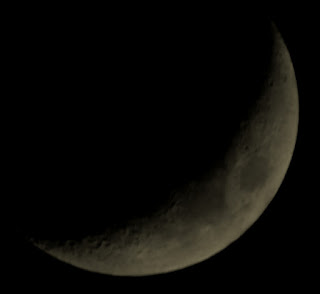
This day will probably be best remembered for Storm Eunice. It cleared in the evening but it was still windy. I did not venture from the back door, as I snapped the Moon at 300mm focal length, ISO 100 and 1/1000 second exposure.
February 17th Reprocess
I reprocessed a star shot showing parts of Cetus and Aquarius.
I checked the rest if the frames but they were getting more misty with condensation and nome of them contained any meteors or UFOs.
February 16th 2215 GMT Moon
It was a very stormy day but it cleared somewhat during late evening. Even then, not a single star was visible but I was able to get a shot of the Moon at 300mm focal length, ISO 100 and 1/1250 second exposure.
February 16th Constellation Reprocess
With wall-to-wall cloud and rain varying from light drizzle to tropical storm, I carried on processing my big photo shoot from November 5th. This was another star field that showed parts of constellations but nothing in full.
February 15th Constellation Reprocess
I continued reprocessing constellation shots from November 5th 2020. Here was yet another Aquarius.
The next set of frames does not show any constellations in full but parts of Aquarius, Pisces and Cetus.

The next set of frames shows parts of Aquarius and Cetus.
February 14th Moon and Betelguese
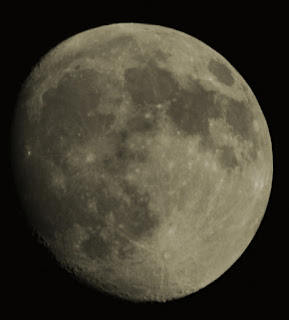
The Moon was almost full but there was still a noticeable terminator and it was showing quite a few craters. I snapped it at 300mm focal length, ISO 100 and 1/1250 second exposure.
Betelguese as, at least apparently, misbehaving again! It seemed about the same brightness as Procyon. With the different colours, it was difficult to tell, so a conservative estimate was 0.4 for the magnitude,
February 14th Constellation Reprocess
Continuing from November 5th 2020, the next set of frames nailed Aquarius and this was my first shot of it.
I did not process a full set of frames for the next shot, as I wanted to catch Capricorn and it was only in view for 11 frames. I still caught Aquarius.
The next set of frames showed Aquarius well, with Capricornus rotating off and more of Pisces and Cetus rotating on.
February 13th Constellation Reprocess
Again, I was revisiting November 5th 2020 and I found some frames that I had somehow forgotten to process. Even better, they were in a part of the sky where I have no previous photos. It was in the Pegasus/Aquarius part of sky but neither were shown in full. The faint constellation Equuleus, representing a little horse, is the only complete constellation shown. I was meteor hunting and stacked 30 of 40 frames to get the result.
February 13th Jupiter with Saturn Reprocess
I reprocessed a widefield shot of Jupiter and Saturn, also from November 5th 2020.
February 12th Jupiter with Moons Reprocess
I reprocessed an image of Jupiter with its moons from November 5th 2020.
February 12th 0025 GMT Moon
We idealise astronomy as clear skies, a camera taking images automatically while we browse the sky visually. These days happen but not as often as we'd like, especially if we live in places like south west England, where cloud is the predominant weather pattern.
So it was one of those cloudy Friday evenings where no viewing was possible, due to cloud, and Sirius looked as if it was third magnitude. I was letting our dogs out, prior to bedtime, when the Moon was in a clear patch of sky. I returned with my DSLR at 300mm focal length, ISO 100 and 1/800 second exposure. In retrospect, the original image was under-exposed but my processing soon fixed that!
February 11th Solar Reprocess
I reprocessed a solar shot from November 5th 2020.
February 11th 1220 GMT Sun
I bin scanned the Sun but could not detect any of the sunspots on the Learmonth images.
February 10th 1930 GMT
Betelguese
The Moon was too bright for
constellation, meteor or deep sky photography. I checked the brightness of
Betelguese and estimated it at 0.5.
I snapped the Moon at 300mm focal length,
ISO 100 and 1500 second exposure.