February 27th 1820 GMT
Venus and the Moon were high in the south west. I took some
shots of the Moon at 300mm focal length, ISO 100 and 1/200 second exposure.
I took some shots of Venus at 300mm focal length, ISO 100
and 1/320 second exposure.
I took some shots of them both together at 150mm focal
length, ISO 100 and 1/100 second exposure. Well, at least I had a passable result.

February 25th 0140 GMT Deep Sky
It was clear again when I went outside. M35 was low and
behind the trees, so I went for the Beehive (M44) at various settings and also
tried the polar regions at 300mm focal length, ISO6400 and 30 seconds exposure.
First was 16 exposures at 70mm focal length and 10 seconds exposure.

The intermediate shots at 150mm did not focus. The frames at 300mm and 2.5 seconds exposure focussed but did not stack. I processed a single frame.

Some of the polar region frames were blurred but 3 were "clean", so I stacked them. The result, while pleasing can give a false impression. I was able to use a long exposure time and long focal length because there is very little star trailing near the celestial poles.


February 24th 2320 GMT Deep Sky
On late winter evenings, I prefer to get out earlier to catch some of the winter stars before they set. However, it did not clear until just after 2300. I went out with my DSLR and 70-300mm zoom lens and set the ISO to 6400. I was hoping for a longish session but cloud moved in before I could get a decent pot at M35, so I switched to another target before cloud forced an early end to the session.
I started off with five frames of the Hyades at 70mm focal length and 10 seconds exposure.

I tried to take multiple frames of the Pleaides (M45) but only one frame was in focus. However, it turned out quite well.

My M35 and Melotte 20 shots were out of focus.

My M35 and Melotte 20 shots were out of focus.
February 20th 2245 GMT
It started off clear but cloud moved in, so I kept switching targets. I set my DSLR to 16mm focal length, ISO 1600 and 30 seconds exposure, standard constellation settings.
My first target was Orion but cloud moved in, only allowing a single frame. Photographically, Betelguese seemed brighter than it had appeared visually, strange, as most photographs I had seen around the same time showed it as fainter than Bellatrix, the star 45 degrees towards the bottom corner.

I than aimed at Monoceros, a constellation that I had never photographed before.

I rather like Taurus, so had a go with a few frames but there was encroaching cloud.
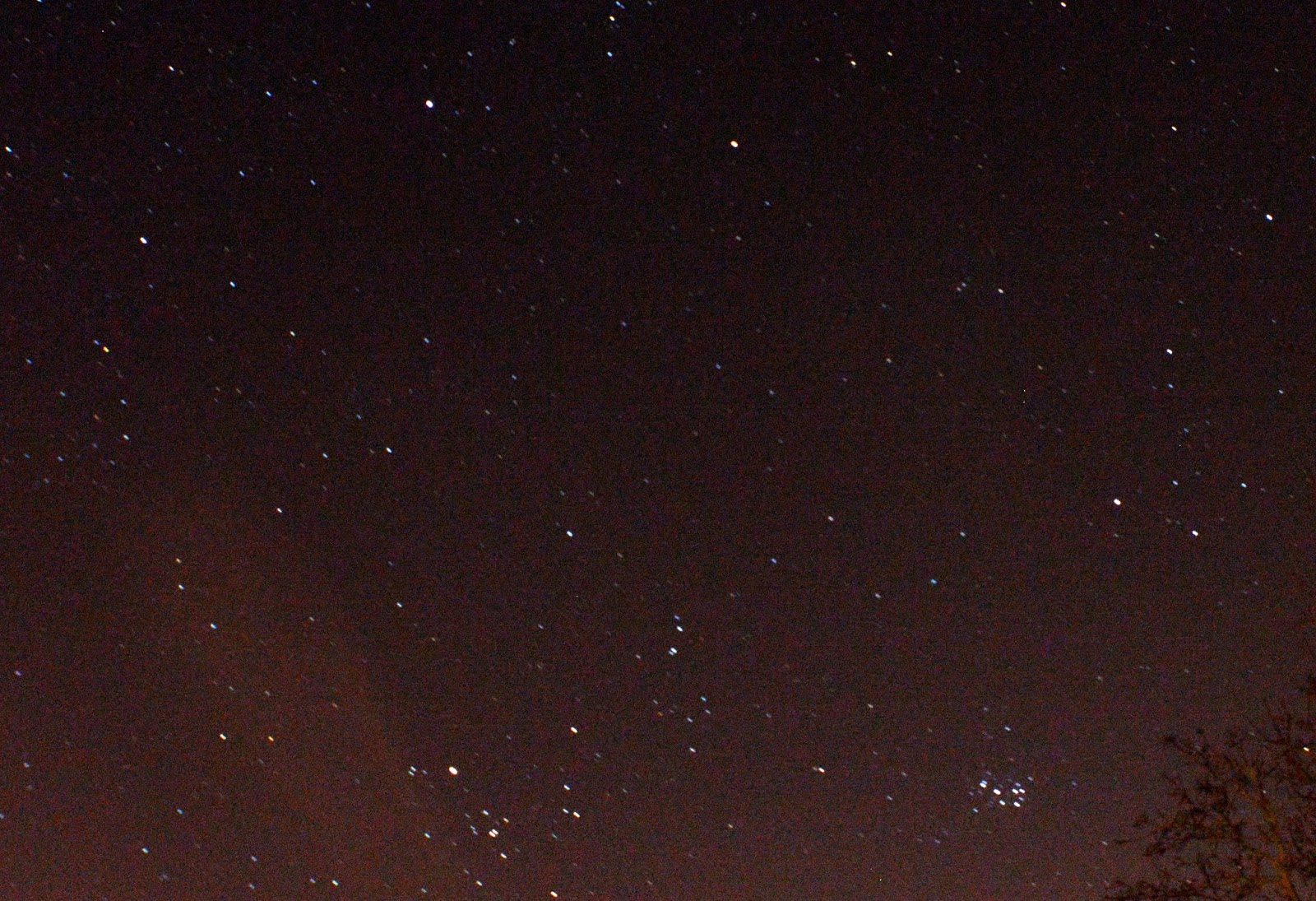
I went for the Hyades at 36mm focal length, ISO 6400 and 10 seconds exposure. Unfortunately, I did not get the focus right.
I ended up at the north celestial pole with the same focal length and ISO but 30 seconds exposure. The focus did not work either.
February 20th 1900 GMT
I snapped Venus with my Mak and DSLR at 1.54m focal length, ISO 100 and 1/320 second exposure. I removed a lot of false red and blue colour on processing. The phase was smaller than 9 days before.

I also saw Betelguese and it was brighter than both Castor and Bellatrix, so was again about magnitude 1.45.
February 19th 0020 GMT Deep Sky and Widefield
I had another clear spell and decided to have a go at photography. Although they were near the horizon and surrounded by trees, I took a frame each of the Hyades and Orion's Belt at 70mm focal length, ISO 6400 and 8 seconds exposure.


I then aimed at the star cluster M35 in Orion, firstly with the same settings.

I took some frames at 150mm focal length and 4 seconds exposure.

I took some more frames at 300mm focal length and 2,5 seconds exposure.
These were out of focus, so I cropped and resized the above image.


I finished with some frames of Canis Minor at the original settings.

February 18th 2140 GMT Betelguese
There was a brief period of clear sky in the south west. I was able to compare the brightness of Betelguese with Castor and Bellatrix. It had brightened to about magnitude 1.45, noticeably brighter than Castor (magnitude 1.6).
February 12th 0650 GMT Moon
The waning gibbous moon was low in the west. I took some
frames with my DSLR at 300mm focal length, ISO 100 and 1/500 second exposure.

February 11th 2235 GMT Moon
The waning gibbous moon was high in the south east. I took
some frames with my DSLR at 300mm focal length, ISO 100 and 1/500 second
exposure.

February 11th 1750 GMT Venus
I took some frames of Venus with my Mak and DSLR at 1.54m
focal length, ISO 100 and 1/50 second exposure.

February 10th 2235 GMT Moon
The previous 50 hours had been stormy, with lots of rain and almost continuous cloud cover. It finally cleared and there were just a few clouds. As the air was humid and the winds still strong, I just took some DSLR frames of the Moon at 300mm focal length, ISO 100 and 1/640th second. Unusually, selecting the best frame to process was rather hard, as about half of the frames would have produced a good result.
I was pleased with the result, especially with the detail along the terminator and the display of Tycho's rays. Mare Crisium sat nicely near the terminator, too.

February 8th 1750 GMT Moon and Venus
Conditions had deteriorated somewhat since my so9lar session
earlier, so I just used my DSLR at 300mm focal length and ISO 100.
I snapped the nearly full moon at 1/1250 second exposure.

I snapped Venus at 1/320 second exposure. Unfortunately, I did not get a good result.
February 8th 1240 GMT Sun
On the 39th day of 2020, I finally saw something potentially interesting on the Sun in hydrogen alpha light on the Big Bear images. The solar disc in normal (white) light was bland, as it had been for a long time.
With a clear sky, I went out with my PST. I did not see any prominences but some shading, after a bit of fine focusing and tuning of the filter. I took some afocal shots with my DSLR, more in hope than expectancy.

February 6th 2110 GMT Moon
The conditions were much better than the preceding days but
the Moon was high and bright, drowning out most stars fainter than magnitude
2.5. I reduced my exposure time to 1/800 second, due to the lunar brightness.

As Betelguese and Bellatrix were both visible and they were
very close in brightness, it suggested that Betelguese had faded a bit further,
almost to magnitude 1.6.
February 5th 2010 GMT Moon
Conditions were a bit better than the night before but only
the main stars of the constellations were visible. The Moon was high, bright
and gibbous and I took a few frames with my DSLR at 300mm focal length, ISO100
and 1/320 second exposure.

February 4th 2125 GMT Moon
There was lots of moving cloud about but a clear patch
allowed me to take a few frames of the Moon with my DSLR. I changed the
settings slightly, reducing the exposure time to 1/320 second.
I was quite pleased, as I caught Sinus Iridum (Bay of Rainbows) on the terminator.

February 3rd 1910 GMT Moon and Venus
There was some cloud around but I had a go at snapping the
Moon and Venus, using the same settings as the evening before.


February 2nd 2020 GMT
Conditions improved later, even though there was cloud about and few stars were visible.

February 2nd 1900 GMT
Conditions were very poor, with moving cloud moving in front
of the Moon. I took some frames at 300mm focal length, ISO 100 amd 1/125 second
exposure, the latter to counteract the cloud.


