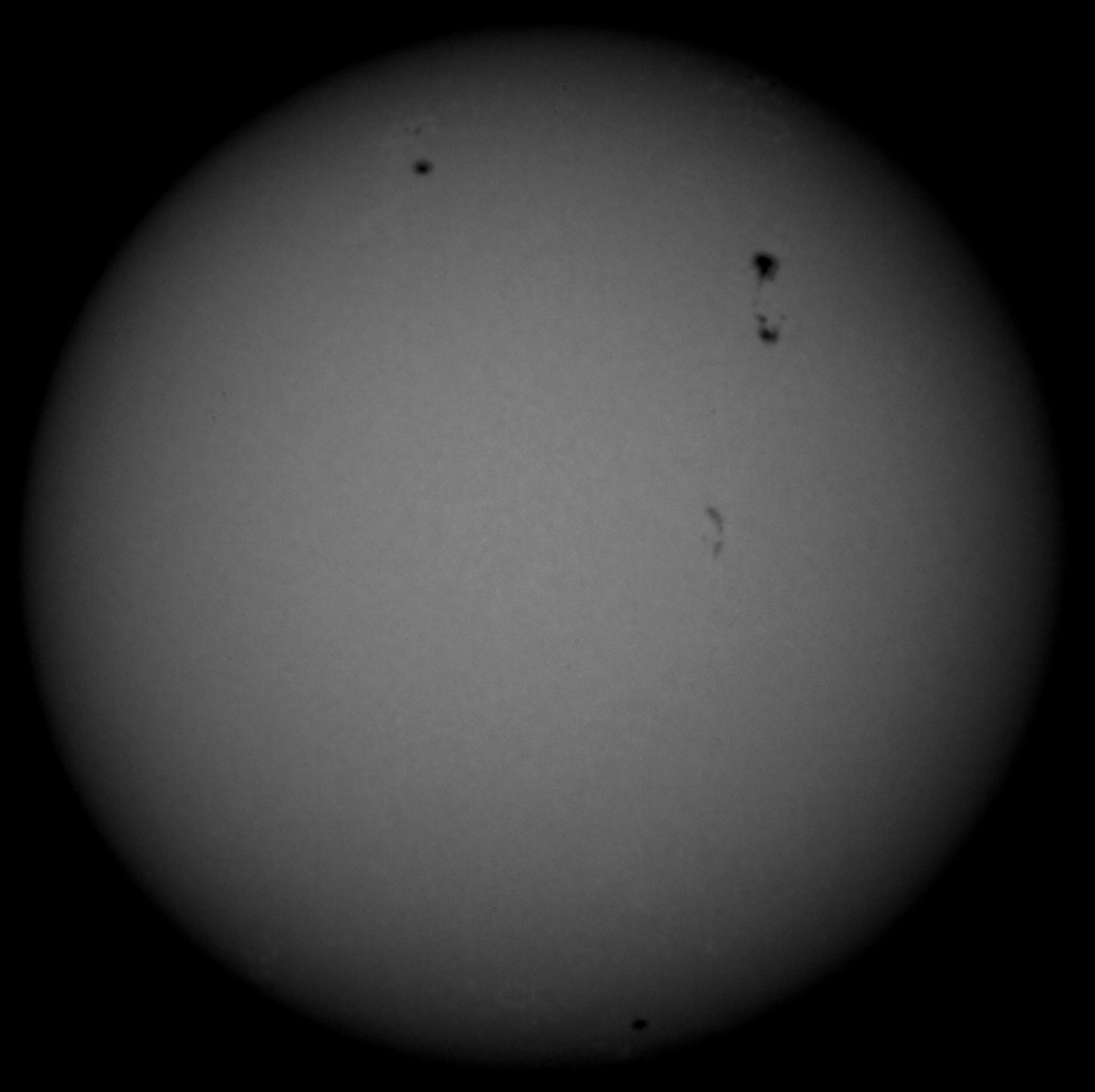
January 31st 0930 GMT Sun
Against the weather forecast, there was some clear sky. I photographed the Sun with my Mak telescope and DSLR at 1.54m focal length, ISO 100 and 1/500 second exposure.

January 30th 2205 GMT Constellation Shoot
I set my DSLR camera to 18mm focal length, ISO 1600 and 30
seconds exposure.
First up was Orion.

I then tried for Lynx, capturing Mars in Gemini and Cancer but, alas, only part of Lynx.

I got a couple of shots of Auriga at 30mm focal length, ISO 1600 and 15 seconds exposure before cloud rolled in.

January 30th 1950 GMT Mars and Jupiter

January 30th 1905 GMT Planetary Shoot

I tried the same settings on Jupiter then Mars. Few details on Jupiter and none on Mars.


I changed the settings to 70mm focal length, ISO 6400 and
1/25 second exposure and took multiple images of Mars with Castor and Pollux.

I changed the settings to 300mm focal length, ISO 6400 and
1/40 second exposure and took multiple images of Jupiter, hoping to catch the
moons. I caught two.

I tried the same settings on the Orion Great Nebula (M42). They did not work.
January 30th 1120 GMT Sun
I photographed the Sun with my Mak telescope and DSLR camera at my usual settings of 1.54m focal length, ISO 100 and 1/500 second exposure.

January 30th Scorpius Reprocess

January 29th Canis Major Reprocess

January 29th 0215 GMT Leo
I photographed Leo with my phone camera but was unable to run a stack, so processed a single image.

January 28th 1950 GMT Jupiter and Mars
The weather had been awful but a gap appeared in the cloud which allowed me to do a quick shoot of the two objects together.

January 25th 1950 GMT General Shoot
I had a go at Jupiter at 300mm focal length, ISO 100 and 1/250 second exposure in an attempt to capture surface details.
I tried Jupiter's moons at 300mm focal length, ISO 6400 and 1/2 second exposure.
I had another go at 70mm focal length, ISO 6400 and 6 seconds exposure.
I used the same settings for the Orion Great Nebula and Orion's belt.
The only clear image was the Orion shot, as all others had too much distortion.

January 25th 1925 GMT Planet Shots
I did a quick shot of Venus with Saturn at 70mm focal
length, ISO 6400 and 1/50 second exposure.

I used the same settings for Jupiter's moons but afterwards thought I should have used 300mm focal length. I should, as nothing showed.
I snapped Venus alone at 300mm focal length, ISO 100 and 1/250 second exposure. It suggested (falsely!) a larger phase than my telescope shot a few days before.

January 25th 1900 GMT Planets Widefield
I went out with my phone camera. I shot Venus with Saturn and then Jupiter with Mars. I used it at default settings.


January 25th 0955 GMT Sun

January 24th 1410 GMT Sun
I checked the sun with my binoculars and filters. I saw the same large sunspot as the day before and it had rotated nearer to the edge of the disc.

January 23rd 1420 GMT Sun
Between heavy showers, the sun appeared. I checked it with my binoculars and filters but I was only able to see a single large sunspot.

January 22nd 1920 GMT Jupiter and Mars
It had clouded over since I photographed Venus and Jupiter. I could see Jupiter and Mars, so did some shots of them with my phone camera at default settings. Mars had been travelling retrograde, so was close to Castor and Pollux. I also caught a satellite trail.

January 22nd 1730 GMT Venus and Jupiter
Following a cloudy day, the sky unexpectedly cleared after sunset. Venus was high in the south west. I snapped it with my Mak telescope and DSLR camera at 1.54m focal length, ISO 100 and 1/500 second exposure.
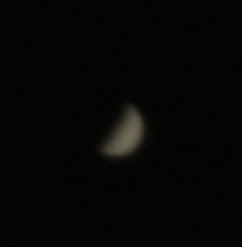
I used the same settings to snap Jupiter. I underexposed it but still managed to catch the cloud belts/


I combined the two photos.

January 21st 1125 GMT Sun
The cloud was thinner than the day before and I was able to see a 4th sunspot.

January 20th 1255 GMT Sun
I saw sunlight but when I checked, the sun was behind cloud. However, enough sunlight got through, at times, and I was able to see three fairly large sunspots through my binoculars and filters.

January 15th 1955 GMT Moon and Mars
I was going to do a Moon shot with my Mak and DSLR but fog
had started to roll in. I snapped the Moon with my DSLR at 300mm focal length,
ISO 100 and 1/800 second exposure.

I snapped the Moon with Mars with my phone camera at default
settings.

I combined the two to produce a composite image.

January 15th 1730 GMT Planetary Shoot
Venus and Saturn were close. I could even get them into the
field of view of my DSLR camera at 300mm focal length. I set the ISO to 6400
and 1/50 second exposure.

I used the same settings on Jupiter, hoping to catch some moons. Only one shot was sharp enough but the Exposure function in GIMP did the trick.

I rest the ISO to 100 and exposure to 1/200 second to try Jupiter. I caught the main cloud belts in one photo.


I ended up increasing the exposure to 1/50 second to try Saturn. This did not work either, for similar reasons.
The Venus and Saturn shot was the only one I realistically expected to work but I'm not adverse to trying things out. I managed to get some cloud belts on Jupiter, which as happened before but is rare. I think the quick shot showed it is potentially possible to catch its moons without any need for a tripod. Cause for more experimentation.
January 15th 1635 GMT Venus
Venus was high in the west. I snapped it with my DSLR at 300mm focal length, ISO 100 and 1/500 second exposure.

January 15th 1525 GMT Sun
The sky was clear but the sun was low in the south west, barely above our fence. I checked it with my binoculars and filters and saw what looked like a single, large sunspot.

January 12th 1920 GMT Venus, Saturn, Moon, Jupiter and
Mars
Conditions were somewhat hazy but I was able to do a shoot with my phone camera.
The first was Venus with Saturn at default settings but a zoom of 2.5 times.

I reverted to zoom level of 1.0 and took photos of the Moon
with Jupiter, Moon with Mars, then all 3 together.


January 11th 1105 GMT Sun

January 10th 2035 GMT Moon and Jupiter

January 10th 1845 GMT Moon and Jupiter
I was recovering from illness, so I wasn't ready to go out. I snapped the Moon and Jupiter with my phone camera at default settings from an upstairs window.

January 6th 1655 GMT Moon and Venus
It was dusk and there was some moving cloud around. I set my
DSLR to 300mm focal length, ISO 100 and 1/400 second exposure and took some
separate shots of the Moon and Venus.


After putting the shopping away, I took my telescope and DSLR camera out.
I photographed the Moon at 1.54m focal length, ISO 100 and 1/200 second exposure. I stacked 5 images in Autostakkert and finished in GIMP.

When I photographed Venus, I reduced the exposure to 1/500 second exposure. Despite it being theoretically better than the overexposure of the evening before, it did not work.
I disconnected my DSLR camera from my telescope and attached a zoom camera lens. I set my camera to 300mm focal length, ISO 100 and 1/200 second exposure to capture the Moon and Venus. The stack did not work, so I processed a single shot.

January 3rd 1520/1605 GMT Moon and Venus
I did some shopping and. when I arrived at the car park, I could see the moon very clearly. I could see Venus above it, even though the sun was above the horizon. The sun was still above the horizon when I got back, so I snapped the together with my phone camera at default settings.

January 3rd 1130 GMT Sun
I had some clear sky again, so photographed the Sun with my Mak telescope and DSLR camera at my usual settings of 1.54m focal length, ISO 100 and 1/500 second exposure.

January 3rd 0225 GMT Mars in Gemini
January 2nd 1835 GMT Saturn and Venus
I used my phone camera at default settings to capture Venus with Saturn. Unfortunately, this did not work.
January 2nd 1640 GMT Moon and Venus

I used the same settings for Venus, perhaps unwisely.

I switched to my DSLR camera alone and snapped the two
objects together at 45mm focal length, ISO 400 and 1/40 second exposure.

I tried Jupiter at 45mm focal length, ISO 6400 and 1/40 second exposure, in the hope of catching something. I( didn't capture any moons (as hoped) but did catch a hint of the cloud belts. This did not load in Blogger.
January 2nd 1020 GMT Sun
I awoke to bright sunlight and got into action immediately. The
Sun was showing lots of small sunspots and I photographed it with my 127mm
Maksutov telescope and DSLR camera. The settings were 1.54m focal length, ISO
100 and 1/500 second exposure.

January 1st 2250 GMT Sirius, Orion and Jupiter
I took a few shots of Sirius and Jupiter each side of Orion with my phone camera at default settings.

January 1st 2050 GMT Jupiter and Mars
I was putting a bag of rubbish out when I noticed that there
was some clear sky from Betelguese upwards. I snapped 20 frames of Mars and
Jupiter and a few more dark frames.