Friday, April 1, 2022

April 2022

April 30th 0920 GMT Sun

I bin scanned the Sun in clear sky. The excitement of the activity earlier in the month had died down but I still detected two sunspots. It was the final action of the month.


April 29th Flying Hockey Stick Reprocess

I am currently reprocessing only to support my writing for "Astrophotography with a DSLR". This was the flying hockey stick I found on January 29th.


April 29th 2050 GMT Meteor Hunt

It was not perfectly clear, nor was it completely dark. With the sky expected to clear later, I set my camera with my brand new intervalometer at the usual settings. While our dogs were outside, I had a look in the direction of Lyra. Although there was haze, I could see Vega, Deneb and parts of Draco. I did not see any meteors, so came back inside, more in hope than expectancy.

One of the by-products of my meteor searches is a set of constellation photos. I stacked a few early frames to catch Ursa Minor and parts of Draco, including the head.


At 2130 GMT, I struck gold with a Lyrid meteor near the Dragonhead.


I tried another few frames of Ursa Minor and the Dragonhead and thought this was slightly better.


At 2144 GMT, I caught a much fainter meteor, near the pole, but it was not from the Lyrid shower but a sporadic one.


At 2204 GMT, I caught an unidentified object which showed what appeared to be two converging trails. like ET having a meeting in space. As my usual UFO sightings, nothing was visible in the preceding nor following photos. The part of the sky was the "Keystone" asterism in the constellation of Hercules.


I stacked 30 of 40 images to catch Hercules with Corona Borealis and the Dragonhead is on the lower left.


I caught another sporadic meteor at 2230 GMT, near the Pole Star.


At 2232 GMT, I caught part of a bright sporadic meteor trail on camera.


At 2233 GMT, I caught another sporadic meteor, but much fainter, near the Dragonhead.


It was only faint but I caught a Lyrid shower meteor in the Keystone of Hercules.


I caught two meteors in the same frame, a few seconds later but processed them separately, as they had short trails.


At 2311 GMT (Saturday 30th but still the same session) I went out to reset the camera and saw what looked like a very bright comet or galaxy above our house. I had no idea what it was but it started to move. I did not have time to reset the camera before it went out of view. The long exposure showed a short but bright trail and I caught two images. The blue colour was not noticeable to the unaided eye.


I stacked a few frames to catch Lyra and Hercules.


The final few frames were similar but showed a little bit more of Cygnus.


So what I saw as a session that started off with more hope than expectancy turned out to be a real cracker. I caught meteors, a UFO and processed a few frames to produce some constellation shots. It was May 2nd before I finished processing and blogging. What a night!


April 29th 1245 GMT Sun

I caught some clear sky and this time I caught two sunspots but the exciting action of a few days before was just about to rotate off.


April 28th 1230 GMT Sun

Conditions were, frankly. horrendous. It was a miracle I saw anything at all but I caught a sunspot through the murk. I'm sure that others were around but I'm glad I got the one I did.


April 26th 0655 GMT Sun

I bin scanned the Sun and saw that the sunspots had rotated since my last view. A small one had rotated on.


April 24th Morning: Sun

I woke up to poor conditions but was able
to catch glimpses of the Sun through thick cloud. I was able to see all but the
fainter of the sunspots I had seen the evening before. I was not able to see
the sunspots long enough to record the pattern on paper.

About 0820 GMT, it cleared am bit more and I was able to try out my new filter I hade made for my camera. I used 300mm focal length, ISO100 and 1/4000 second exposure.


I captured the main sunspots but did not nail the focus.

April 23rd 1655 GMT Sun

Fortunately, I did not have long to try my new filter out with my binoculars. I had been struggling for months with a filter that was made for an 80mm telescope. My new purpose-built filter revealed detail in the sunspot pattern that I hadn’t seen for a long time.


April 23rd Morning: Gear Upgrades

I was faced with 100% cloud cover. With no solar observations possible, I decided to make some new filters for my binoculars and camera. I had hoped to make one for my 127mm Maksutov but did not have any filter material left. I had to come up with a Plan B, which involved unpacking my old filters and finding a solution. I left that until later, possibly another day. I wrote this while waiting for my filters to "set".

On 22nd my replacement intervalometer but I was unable to use it for the Lyrid meteor shower because there were only small patches of clear sky. Still it was nice to know that I had the means to return to meteor hunting, which I even do on clear nights, even when no major showers are visible.

Another issue I had was that the lead that connected by Bresser Electronic Eyepiece to my PC was lost in the house move and I tried to look for a replacement. Instead, I ordered a similar device for a tenner but it was not due to arrive until mid-May.

That had blown my budget for the foreseeable future!

April 21st 0545 GMT Sun

I bin scanned the Sun in quite clear conditions. I saw the same three sunspots as before and noticed that they had rotated. The Learmonth images showed a lot more detail, suggesting that I needed to make a solar filter for my 127mm Maksutov.


April 21st 0515 GMT Moon

The Moon was a difficult target, low in the south west. I snapped it with my DSLR at 300mm focal length, ISO 400 and 1/250 second exposure.


April 19th 1100 GMT Sun

I bin scanned the Sun under poor conditions but managed to see three sunspots.


April 18th 2310 GMT Moon


My long-awaited return to telescopic photography finally arrived. I took some shots of the Moon with my Mak and DSLR at 1.54m focal length, ISO 100 and 1/500 second exposure.

For processing, instead of stacking lots of frames, I kept varying the focus to select the best one and processed the single frame.


I then took some shots of objects of interest at 4.62m focal length, ISO 100 and 1/50 second exposure. I did not go to any longer focal length, as the lunar disc was shimmering and I would not get a steady image.

The first close-up was of Mare Crisium.


The second shot caught Linne, a small crater with a bright floor and the better-known Kepler/


The third shot was of Tycho, with its ray system.


The fourth shot was in the north west, showing many craters.


The fifth shot was another go at Linne and Kepler, with parts of Grimaldi to the bottom.


On the subject of Grimaldi.


Then there was Plato in the middle of the lunar Alps.


April 17th 1000 GMT Sun


With my 70mm binoculars having failed to detect a single sunspot, I needed something with a bit more aperture.


It was a long bank holiday weekend, so I had no rush, so I unpacked both of my Skywatcher telescopes, my ST80 and 127mm Mak.


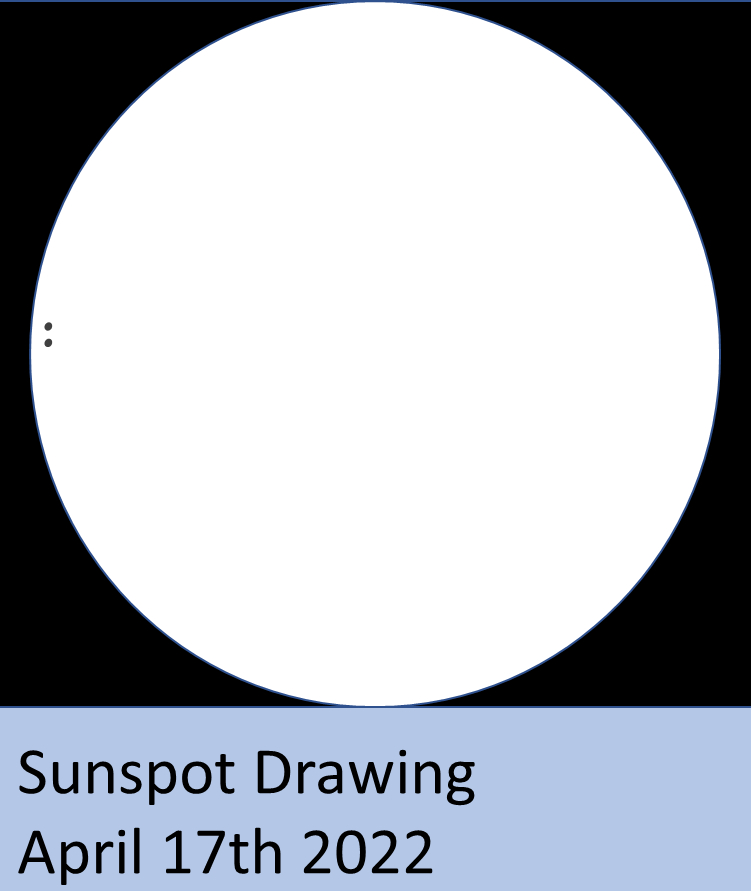
I still needed to make a new filter for my Mak but had a half-decent one that fitted my ST80. Visually, I detected two sunspots and made a drawing. My focusser needed some attention. It was OK-ish for visual use but useless for photography.


April 16th 2220 GMT Moon


I was going to snap the Moon earlier in the evening but it was too hazy. It was over 3 hours after full before I could get a shot. I used my DSLR at 300mm focal length, ISO 100 and 1/2000 second exposure.


April 16th 0045 GMT Moon


The Moon was about 18 hours before its full phase. With only brighter stars visible in the bright moonlight, neither deep sky nor constellation photos were possible.


I had another go at the Moon, less than four hours after my last photo and used the same camera settings.


April 15th 2100 GMT Moon


I snapped the Moon at 300mm focal length, ISO 100 and 1/2000 second exposure.


April 14th 2100 GMT Moon


There was a lot of cloud and haze around but I proceeded with a lunar photo shoot with my DSLR at 300mm focal length, ISO 100 and 1/2000 exposure.


April 13th  2050 GMT Moon and Betelguese


I snapped the waxing gibbous moon at 300mm focal length, ISO 100 and 1/1600 second exposure.


Meanwhile, Betelguese appeared brighter than Procyon, despite being lower in the sky. This suggested a magnitude of 0.3, quite different to a mere two days ago.


April 11th 2040 GMT Moon


There was some haze around but I snapped the Moon with my DSLR at 300mm focal length, ISO100 and 1/1000 second exposure.


April 9th 2100 GMT Moon and Betelguese


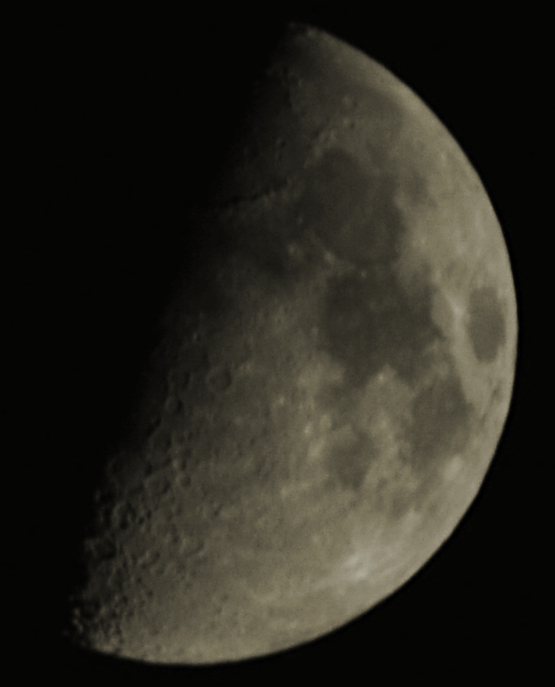
The first quarter moon was high in the west, close to Castor in Gemini. I snapped it with my DSLR at 300mm focal length, ISO 100 and 1/800 second exposure.


I saw Betelguese, Aldebaran and Procyon. As there was some light cloud around, the estimate was far from reliable but I guessed that Betelguese was about magnitude 0.5.


April 8th 2100 GMT Moon

I snapped the Moon with my DSLR at 300mm focal length, ISO 100 and 1/640 second. 


April 7th 1920 GMT Moon

I snapped the Moon with my DSLR at 300mm focal length, ISO 100 and 1/400 second. I caught many features but didn't quite nail it.


April 7th 1100 GMT Sun

The weather was quite difficult, with a lot of moving cloud but I managed to see the large sunspot about to rotate off.


April 5th 1100 GMT Sun

The weather was actually better than the forecast, with one large sunspot becoming foreshortened as it approached the limb.


April 3rd 1920 GMT Moon


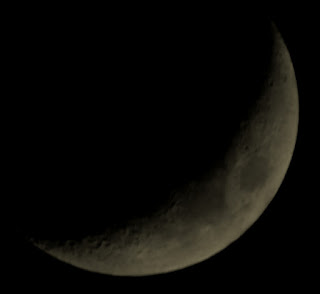
The Moon was two days past new and surprisingly high in the west.

 I snapped it with my DSLR at 300mm focal length, ISO 100 and 1/200 second exposure.


I reprocessed another frame and this came out somewhat better.


April 3rd 1000 GMT Sun

I woke up to clear sky and immediately bin scanned the Sun, knowing that the weather was predicted to change later. The sunspot had rotated and changed shape.


April 2nd 2125 GMT Deep Sky

I did some deep sky photography with my DSLR at 70mm focal length, ISO 6400 and 8 seconds exposure.

I tried the Hyades star cluster but it was too low in the sky and partially blocked by a house.

I quickly moved on to Melotte 20, otherwise known as the Alpha Persei Cluster. The images were ruined by our TV aerial and one of the joins did not work on the stack. However, the cluster came out well, so I just cropped out the <expletive>.


I got a full field of M35 and its surroundings with the same settings.


April 2nd 2030 GMT Betelguese

It was clear in the west, so I could see Orion. Since I last checked, Betelguese had faded to magnitude 0.5.

April 2nd 1010 GMT Sun

Conditions were bad but I was still able to see the large sunspot that had rotated.


April 1st 1100 GMT Sun


There was a lot of moving cloud but enough clear sky to catch some sunspots.


Wednesday, March 2, 2022

March 2022

March 31st 0715 GMT Sun

After 4 days, the weather cleared to show a great sunspot pattern.


March 27th 2000 GMT Melotte 111

I took a few shots of the open star cluster Melotte 111. I stacked the best 7 to get a nice result.


March 27th 1200 GMT Sun


I bin scanned the Sun using my filters. The sunspot pattern had changed again and one was especially large.


March 26th 0800 GMT Sun


I bin scanned the Sun with my filters and found that the sunspots had rotated and changed shape.


March 25th 0725 GMT Moon


The Moon was low and it was full daylight. Despite my best efforts, the result was somewhat patchy.


March 24th 1200 GMT Sun


There were a few clear days but, unfortunately, there had not been any sunspots since March 14th. New activity rotated on and I saw a sunspot in my binoculars and filters.


March 23rd 0550 GMT Moon and Venus


The Moon was waning gibbous and low in the west. I snapped it with my DSLR at 300mm focal length, ISO 100 and 1/500 second exposure.


I also snapped Venus at 300mm focal length, ISO 100 and 1/320 second exposure.


March 22nd 2000 GMT Constellations and Disaster

My plan was an hours worth of shots in the direction of Leo. However, the connection on my intervalometer broke off and I was unable to use it. I took a few frames manually instead.

I caught a meteor on my 2nd frame.


A few frames stacked to show Leo and some surrounding stars.


March 20th 2100 GMT Meteor Hunt and Constellation Shoot


There was a short period of darkness between dusk and moonrise. I aimed my camera at Gemini and Canis Minor in hope... I used 18mm focal length, ISO 6400 and 6 seconds exposure.

At 2124 GMT, I caught a short, but bright, meteor trail in Orion.


The constellation shots were marred by dirty lenses and, perhaps, suggested that there was a lot of sensor cleaning to do. On the other hand., by cropping out affected areas, the first set of 40 images showed a decent Gemini.


 The second set of images produced a wider field. It also showed Canis Minor and Cancer.


The third set maybe came out a bit better.


As the next set was very similar to the previous one, I had another go at concentrating on Gemini. The result was not as good as I had hoped.


Gemini had started to rotate from view but Cancer and Canis Minor were still showing well.


The next was a closer shot of Cancer and Canis Minor.


March 19th 2100 Moon and Betelguese

If anything, Betelguese seemed a shade brighter than the evening before but conventional wisdom suggests that the human eye cannot detect brightness differences of less than magnitude 0.1 and I am inclined to agree. So, yes, let's say the magnitude was 0.3 again.

I used a slightly longer exposure of 1/1000 second exposure for the Moon, otherwise I used the same settings as the evening before.


March 18th 2110 GMT Moon

The Moon was higher in the sky and very bright. Through the camera viewfinder, the Moon appeared full but the photo showed a thin terminator to the right. I used my camera at 300mm focal length, ISO 100 and 1/1250 second exposure.


March 18th 1900 GMT Betelguese


It was mid-dusk but some of the constellations were visible. The Moon was low but bright, being just past full. As most comparison stars were visible, I estimated the brightness of Betelguese at magnitude 0.3.

March 17th 0800 GMT Sun


Although there were some sunspots on the professional observatory images, they had faded and I could not detect them with my binoculars and filters.


March 16th 2140 GMT Moon


The Moon was high in the sky and nearly full. Few stars were visible, despite the lack of clouds. There was only one sensible visual or photographic target, namely – the Moon. I took a few shots at 300mm focal length., ISO 100 and 1/250 second exposure with my DSLR.


March 15th  0605 GMT Venus


I hadn’t got a good shot pf Venus in recent weeks but it hard with a DSLR, even with a zoom lens. It is like trying to photograph the Moon with a 10mm lens. I took multiple exposures at 300mm focal length, ISO 100 and 1/320 second exposure.


March 14th 1915 GMT Moon

I had a better shot of the Moon in complete darkness.


March 14th 1620 GMT Moon


The evening forecast was less than encouraging, so I took some shots of the waxing gibbous moon at 300mm focal length, ISO 400 and 1/500 second exposure.


March 14th 1200 GMT Sun

Conditions were far from perfect but I finally managed to see more than one sunspot, with one about to rotate off of the solar disc, plus a cluster of three.


March 13th 2050 GMT Moon

It finally cleared in mid-evening and I snapped the moon at 300mm focal length, ISO 100 and 1/400 second exposure. It was slightly over-exposed.


March 12th 1255 GMT Sun

I bin scanned the Sun through moving cloud. Despite the presence of sunspots on the Learmonth images, I did not see any through my binoculars and filters.

March 12th 1430 GMT Sun

I bin scanned the Sun in poor conditions and saw a single, large sunspot.


March 10th 0640 GMT Venus


I took a look at Venus with my binoculars in the dawn sky. The phase appeared to be a thick crescent, with a 45% phase, but the apparent size was quite small as the planet retreated from Earth.


March 8th 0610 GMT Venus

Venus was low in the dawn sky. Through my camera viewfinder, it looked like a thick crescent phase. I snapped it with my DSLR at 300mm focal length, ISO 100 and 1/200 second exposure.


March 7th 2025 GMT Moon


I snapped the Moon in full darkness at 300mm focal length, ISO 100 and 1/200 second exposure. I did not get the focus I was hoping for but managed a half-decent shot after processing.


March 6th 1650 GMT Moon


I photographed the Moon with my DSLR at 300mm focal length, ISO 400 and 1/200 second exposure. Honestly, it was overexposed but processing sorted it out.


March 4th 2300 GMT Constellation and Meteor Shoot


After a cloudy afternoon and evening, it finally cleared. I aimed my camera at Bootes.


The second set of frames showed Corona Borealis in addition to Bootes and Coma Berenices.


The third set of frames was similar.


As was the fourth.


The fifth was more clear.


For the 6th set of images, Coma Berenices was climbing from the murk near the horizon but was also getting close to the edge of the field of view.


Another set of images left Coma Berenices just visible at the edge of the view.


On the next one, only Bootes and Corona Borealis were shown in full.


The next one was clearer.


The next was similar.


The next one showed a good part of Hercules as well.


As did the next.


The final shot caught all of Hercules.


March 4th Jupiter's Moons Reprocess

I reprocessed a shot of Jupiter's moons from September 6th 2020.


March 4th 1300 GMT Moon

I bin scanned the Sun with my filter. Despite the professional observatories showing 4 sunspots, I only caught one.


March 3rd Moon Reprocess

I reprocessed a moon photo from June 6th 2020.