Wednesday, January 2, 2019

January 2019

January 30th 2045 GMT

I went out again and made sure that my aim was better. I caught many different angles and parts of Perseus, hoping that I could get the whole constellation with the set-up. Well, sooner or later.

It seemed more like later, as I only caught the top half of the constellation.


I managed an image of Melotte 20, though from it,


January 30th 2010 GMT

Further experimentation and investigation showed that the fault in my set-up was the intervalometer and not the camera. I manually set the exposure to 15 seconds and took intermittent frames using a rote shutter release. ISO was 6400 and focal length was 35mm.

Unfortunately, my aim was out again, as I just caught the top of Perseus and caught just the top of the constellation, featuring Melotte 20 again.

January 30th 1230 GMT

The Sun was diving in and out of clouds but I tried a solar hydrogen alpha shot regardless.


January 28th 1010 GMT

I had some unexpected clear sky, so did a solar hydrogen alpha shoot. The Sun, however, was quiet.


January 28th 0015 GMT

I moved the camera towards Cancer, more in hope than expectation. I did not catch the whole constellation but caught a widefield shot of the Beehive (M44).


January 27th 2100 GMT

Well it was clear but I was having trouble with my intervalometer. I ended up taking a few manual shots every few minutes instead. It was the usual setting for my camera with the new lens. It was at 35mm focal length, ISO 6400 and 15 seconds exposure. I started off at Perseus and let the eastern stars drift across. I didn't get anything useable for publication but caught the star cluster Melotte 20 with Capella and parts of Auriga.


January 27th 1330 GMT

There were some more clear patches, so I did a solar hydrogen alpha shoot with my PST. This time, I increased the zoom on my DSLR. I had reverted back to my 70-300mm lens and 32mm Plossl. Even though I could not see any detail visually, I caught a sunspot and some albedo features on camera.


January 27th 1225 GMT


Normally, I would just be going to the shops for a few things. I'm rather good at procrastinating on my days off work and had loads of things that needed doing. However, I had been following some sunspots on the Big Bear and Learmonth solar observatories and there was some clear sun in between moving clouds. I could not recall the last time I had attempted to observe the Sun in white light. It had been unusually quiet throughout 2018. I was surprised to see two small sunspots near the solar limb before clouds rolled in again.


January 25th 2210 GMT


I was still coughing, so I left a camera trap at the southern half of Orion, with the objective of doing a stitch. I set my camera at 35mm focal length. ISO 6400 and 15 seconds exposure. I didn't get any more images but I didn't need a stitch, as I caught the whole constellation.


January 22nd 2120 GMT


I still had my cold and it was sub-zero, so I snapped the Moon from an open window upstairs, with the same settings as the morning.

Unfortunately, the photos were under-exposed and I was unable to extract much detail.

January 22nd 0730 GMT


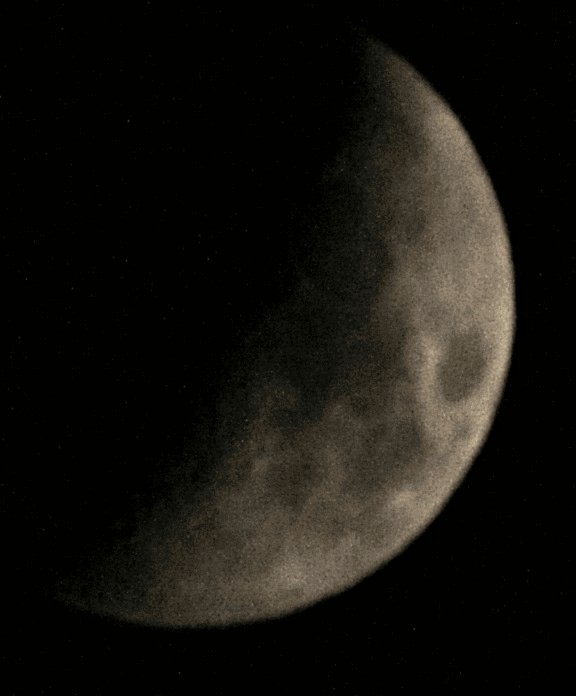
The Moon was just past full and low in the west. I took some shots at 300mm focal length, ISO 100 and 1/1000 second exposure. It was rather nice for a DSLR-only shot.


January 21st 0350 GMT

In the run-up to the lunar eclipse, clouds of various thicknesses were moving over it. Sometimes it stayed cloud-free for a few seconds but never quite long enough to take a photo. By 0200 GMT, it had clouded over completely. I woke up in the night to see a partial phase of about 60% but, again, it did not stay cloud-free long enough. Although I woke up twice during totality, it was 100% clouded out.

January 17th 1240 GMT


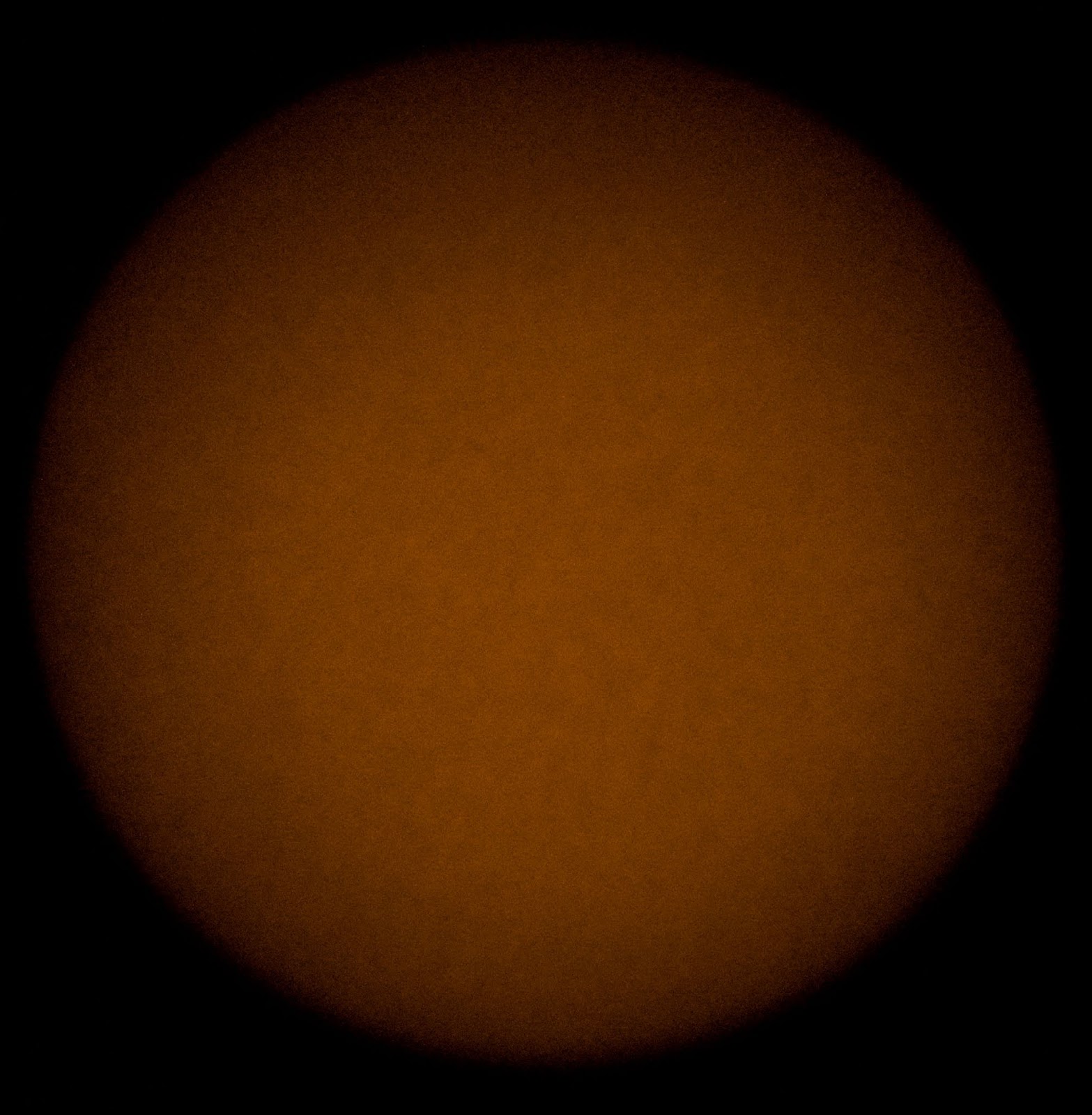
It was clear but even the professional solar observatories were showing a quiet sun. I decided to experiment by using a short focal length eyepiece and my new camera lens. It was harder than I thought. I set my camera focal length to 35mm and, after a lot of trial with my Moonfish 15mm focal length eyepiece, finally settled on my Moonfish 20mm eyepiece. As the professional observatories suggested, I had a very quiet Sun.

My first effort at processing was a disaster but I found that my leaving the red channel and using Curves on the green, the result was not too bad.


January 16th 2040 GMT

Conditions were similar to the evening before, with lots of moving cloud of various thicknesses. I did my usual routine with the Moon and my DSLR. If anything, this was a shade better than the night before.


January 15th 2115 GMT

There was a temporary gap in the clouds. I was not able to get a telescope onto the Moon, as cloud was encroaching again. I took some shots with my DSLR using various exposure times at ISO 100 and 300mm focal length. Even though I write it myself, I think it was rather nice for a DSLR.


January 13th 2340 GMT
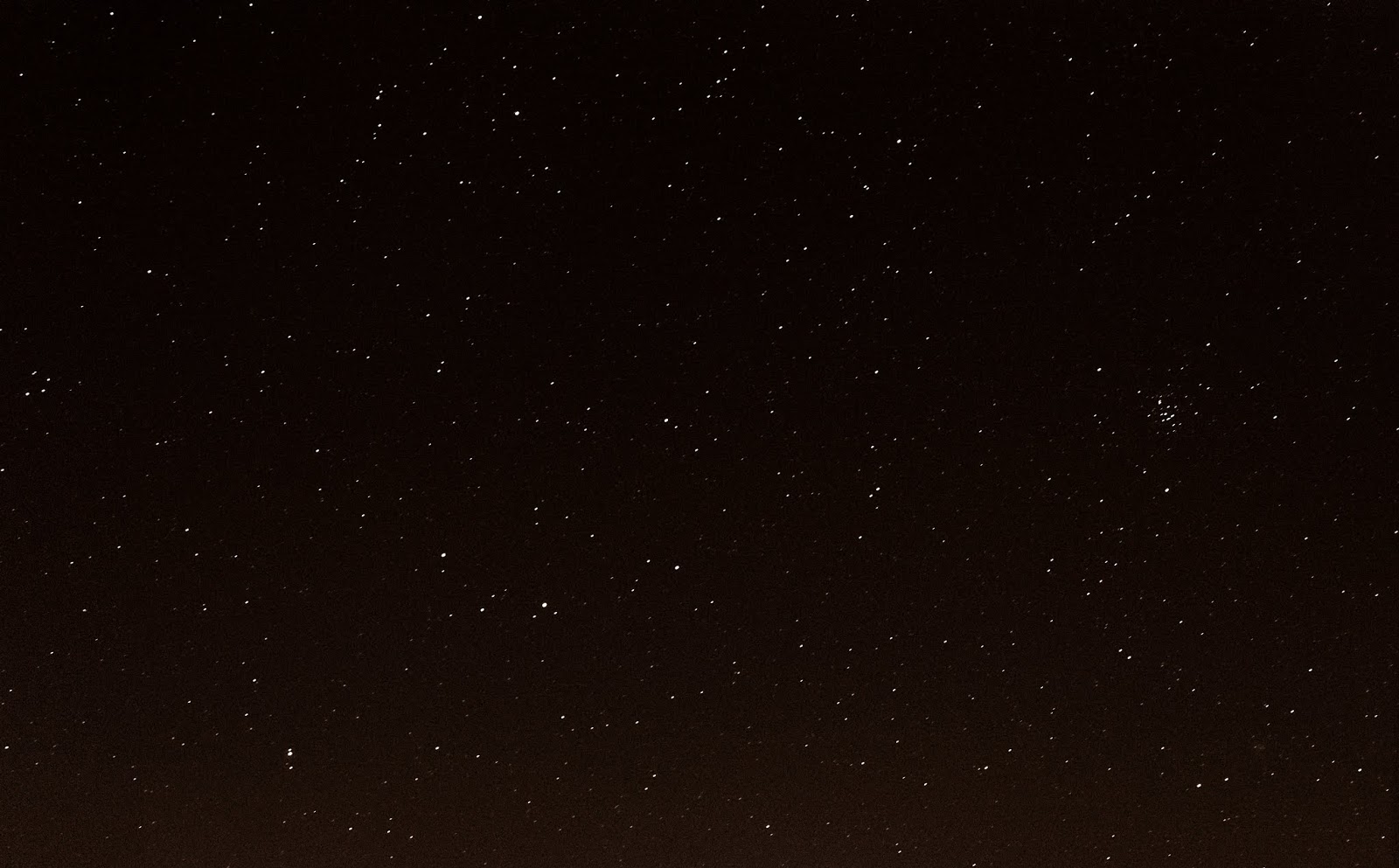

There were some clear patches in the sky, with some moving cloud. I left my camera out in “constellation mode”: 35mm focal length, ISO 6400 and 15 seconds’ exposure. I aimed it at Cancer and left it to do its work. Cloud ruined most frames but I managed to catch the constellation and I was pleasantly surprised how well the Beehive Cluster (M44) turned out.


I caught the Sickle asterism of Leo in another set of frames.


January 9th 1820 GMT


The Moon was a thin crescent phase low in the west. I took some shots at 1/250 second exposure 300mm focal length and ISO 100. I tried a few snaps at 1/25 second to see if I could capture earthshine. I didn't but the crescent was OK.


Straight after it was back to the previous night’s settings, as I aimed my camera at the west side of Taurus. This was a stack of the first 50 frames.


This was a stack of the second batch of 50 frames.


I moved the camera after the third batch, so stacked 26 frames.


The rest of the photos were ruined by cloud, so I stacked the three above,


January 9th 1040 GMT

I checked the Sun with my PST and DSLR. Visually, the Sun had an all-too-familiar feel of being bland and featureless, at least through the eyepiece. However, the photographic result was more illuminating.


January 8th 2140 GMT

After a bit of teasing, a clear patch of sky opened up in the south. I set my DSLR at 35mm focal length, ISO 6400 and 15 seconds exposure and aimed it at Taurus. I had 48 frames that were unaffected by cloud so stacked them using DSS and finished off in GIMP.


January 7th 0720 GMT


As I was getting ready to leave for work, I saw Venus in the morning sky. I checked it with my binoculars and the phase seemed to be about 60%.

January 4th 1800 GMT


After a partially clear day, where the clouds seemed to be gravitationally bound to the Sun, it was a bit more clear in the evening. As I still had a cold, I left my camera searching for Quadrantid meteors while I stayed inside. I set up my camera to 35mm focal length, ISO 6400 and 15 seconds’ exposure.

No luck with meteors but I processed a few frames to obtain a snap of the polar regions.


January 1st 1950 GMT


After yet another cloudy day, it unexpectedly cleared. I used my new lens at 35mm with a 0.45x focal reducer to catch meteors (or at least try!). I used an effective focal length of 15.75mm, 15 seconds exposure and an ISO of 6400. I aimed the camera in the rough direction of M81 to try and catch some Quadrantids. I did not stay out, as I still had a cold.

I left the camera out for almost 2.5 hours but most frames were ruined by some cloud. I stacked 24 of the best frames to get a not bad effort of Ursa Minor.


I caught a satellite trail.


Tuesday, December 4, 2018

December 2018

December 19th 1540 GMT


The waning gibbous moon was low in the east and I took some frames with my DSLR at 300mm focal length, ISO 400 and 1/1000 second exposure.


December 19th 1050 GMT


I had some clear sky but the Sun appeared featureless in hydrogen alpha light, despite a lot of etalon tuning.


December 18th 2215 GMT


It had been very wet but there was finally a clear patch. It was very wet, so I did not feel keen to expose any photographic gear to the elements for long. Comet Wirtanen was also very near the Moon. I did some DSLR shots of the Moon only, using my usual techniques.


December 17th 0105 GMT

After a very wet day, it cleared for a while. It took me some time to track down Comet Wirtanen. Although I could see no sign of a tail, there was a definite condensation in the centre that I hadn’t seen visually before. I took several frames at 70mm and 300mm focal length of the comet and the nearby Pleaides (M45).

This was a composite shot with some frames at 70mm focal length. DSS did not work so I used Microsoft ICE and a lot of processing to get rid of red noise.


The other frames at 300mm revealed less details than the close-ups. Astrophotography is like that sometimes!

December 13th 2240 GMT

I moved the camera to the general direction of M35 and saw a Geminid meteor pass south of Taurus into Cetus.


I only processed one set of frames. The others showed M35 but no meteors.

December 13th 2140 GMT


I was not able to see Comet Wirtanen through my camera viewfinder but set a trap anyway with ISO 6400, 70mm focal length and 8 seconds exposure. I hoped that if I missed the comet, I might catch a Geminid meteor or few.


While the camera was snapping away, I swept the same area of sky with my binoculars. The comet appeared like a large globular star cluster or elliptical galaxy with no sign of a tail. I estimated that the coma was at least a degree across.

The first set of frames showed the comet near the bottom right. Photographically, it appeared to have a brighter centre than it did visually. I also caught parts of the Hyades and Pleiades star clusters,


The second set of frames caught the Hyades in full.


The remainder of the shots showed the Hyades but no meteors.

December 13th 1930 GMT


Conditions were quite poor but I tried to snap the waning crescent moon.


December 10th 0950 GMT


The Sun was low and visible through a gap in the clouds. I would have preferred to have seen it later in the day but the forecast was bad. It showed no detail visually and I was hoping that some would reveal itself in the photos. Well a bit did!


December 9th 2345 GMT

Conditions were the same as the night before, except that different sky patches were clear. However, there was still lots of moving thin cloud around the clear bits and photography was simply not feasible. This time, I saw the Pleaides (M45) again, which showed slightly more stars, the Orion Great Nebula (M42) and the Andromeda Galaxy (M31). The Plough showed quite nicely, so I bagged Alcor with Mizar. It was simply too cloudy to find the comet but I saw the Perseus Double Cluster and Melotte 20.

December 8th 2350 GMT

It was mostly cloudy, with a few breaks in the cloud, one of them, fortunately, being to the south. I kept scanning up and down the Taurus/Cetus borders. Whilst enjoying some widefield views of the Hyades (which I cannot capture in their entirety with my binoculars, it took me some time before I found a faint, diffuse object. It was Comet Wirtanen. Spectacular it wasn't and there was no hint of a tail. I was hoping for some better conditions in the next few days.

I also managed some nice views of the Pleaides (M45) and Beehive (M44) before cloud rolled in and I was pelted by rain. At least I saw some action during a bad period and saw my 21st comet ever.

December 4th 0635 GMT


The Moon and Venus were close together in the morning sky, so I used various combinations of zoom and ISO to capture the event.


December 3rd 2030 GMT


I started later than I expected, as I had to recharge my camera batteries. I aimed my camera at Perseus in an attempt to add to my mosaic. I stacked 25 frames at a time.


This was the stack of the evening's shots and the previous ones. I still haven't finished the constellation yet!


Sunday, November 4, 2018

November 2018

November 26th 1125 GMT


It was clear for a change. I checked the Sun but it looked quiet and did not show the granulation features that it showed a few days before.


November 22nd

I had been “missing in action” for a while, due to bad weather and an even “badder” back! I checked the Sun with my PST. I could see no large-scale features but thought I could see some granulation.


November 14th 1920 GMT


I aimed the camera at Perseus again, just in hope.

Although it was partially ruined by cloud, I caught a meteor near Melotte 20.


The first few frames were cloudless. It was a nice shot, including Melotte 20 but was very similar to others that I'd taken.


This is the Perseus stitch and stack so far. A few more needed.


November 14th 1915 GMT

I took some snaps of the Moon with my DSLR.


November 11th 1625 GMT


I had a look through the Moon with my bins. Mare Crisium was clear of the terminator and some of the southern craters were on show. I followed up with some DSLR shots.


November 11th 1000 GMT


I had not seen the Sun for a few days but I could not see any detail on the disc in hydrogen alpha light. At least there was some detail in the photo,


November 11th 0000 GMT

It finally cleared after days of cloud and rain but not until late evening. As the air was humid, I did not feel comfortable taking any cameras out. With no planets about, it was time for some binocular browsing with my 15x70 binoculars. Although it was quite clear in the north west and I could see the Milky Way, it was somewhat hazy near the horizon.

Unlike recent sessions, Perseus was riding high overhead and it was rather neck-straining to see Melotte 20. The Double Cluster and M34 looked good, too. The Andromeda Galaxy (M31) showed the centre and some structure but I could not spot the Pinwheel (M33). The Hyades and Pleaides (M45) showed well but not any memorably better than usual. I could see the Auriga star clusters M36, M37 and M38, which are not always easy with my binoculars. M35 in Gemini stood out, as did the Orion Great Nebula (M42). I could not see M81 and M82 but spotted the Beehive (M44), although it was low and in the haze.

All-in-all a rather nice session, especially after a lean spell.

November 2nd 1400 GMT

The Sun was quiet in hydrogen alpha light and, even after a bit of etalon tuning, did not show any details.


November 2nd 0900 GMT 

I took some shots of the Moon with my DSLR.


November 1st 2115 GMT


I copied the files from the camera and went out again and aimed the camera at northern Perseus with the same settings.

The three sets of frames caught Melotte 20,


This was the composite of the three.


Finally, the stack so far.


November 1st 1900 GMT


After a stormy day, it cleared in the evening. I aimed my camera at Gamma Andromedae. It was not the intended target but I was hoping to catch more of Perseus. I used 70mm focal length, ISO6400 and 8 seconds’ exposure.

48 frames in, I caught a faint meteor, quite possibly a Taurid.


The first stack gave me the added bonus of splitting Gamma Andromedae.

Here's the second stack.

Here's the third.


Finally, the completed stack.