Summary
Overall, August was a very frustrating month. The weather was particularly bad and I only managed one night of dark sky viewing and photography. Most of my observations were of sunspots under hazy or cloudy conditions. I managed to see a few Perseid meteors but did not photograph any.
The highlight of the month was getting my first decent shot of the Milky Way.

You can see my images from August in a video, accompanied by a live version of “Shine on you crazy diamond” by Pink Floyd:
August 30th
I reprocessed a solar hydrogen alpha shot from August 28th 2012.


August 28th
I reprocessed a solar hydrogen alpha shot from April 21st 2012.

... and another three from April 24th 2012.


August 28th 1415 GMT
The weather was best described as “changeable” but I missed the best spells early morning when work was hectic.
A bin scan showed that the sunspots were even closer to the limb and it might be the last day they would be visible.

August 27th 2030 GMT
It was dusk and I did a photo shoot of the Moon using my DSLR and127mm Maksutov.
I took 124 frames at ISO 400 and 1/800 second exposure.

August 27th 1235 GMT
I bin scanned the Sun and caught it just before it started to rain. The sunspot group was close to rotating off, so I could only see the 2 larger ones.

August 26th 2010 GMT
After a wet early evening it cleared enough for a Moon shoot but conditions were far from good. I only had 27 usable frames at 1/400 second exposure at ISO 400.

August 26th
I reprocessed a solar hydrogen alpha shot from April 21st 2012.

August 26th 1435 GMT
After some quite appalling weather, I bin scanned the Sun and saw that the sunspots had rotated. Their appearance may well have been due to their proximity to the solar limb as any real changes.

August 25th
I reprocessed a solar hydrogen alpha photo from April 17th 2012.

August 23rd 2010 GMT
It was clear and the Moon was low. I took 67 frames at ISO 400 and 1/1000th second exposure with my DSLR and 127mm Maksutov and stacked the best 64. I finished in GIMP, as usual.

August 23rd 1635 GMT
It finally cleared a bit after a wet day and it was nice to see two large sunspots apparently connected by a chain of smaller ones.

August 22nd 1030 GMT
I finally found some sunspots under cloudy conditions, with the Sun being more active than any time recently.

August 19th 0745 GMT
I bin scanned the Sun under poor conditions but did not se any sunspots. The weather forecast was rain, so I grabbed the chance to check the Sun. I had seen two small sunspots on the Big Bear images.
August 18th 0805 GMT
I bin scanned the Sun in a clear sky but did not see any sunspots.
August 16th 2310 GMT
I returned out with my zoom lens at 300mm focal length and ISO setting of 6400. I kicked off with Melotte 20 then proceeded to attempt:
Andromeda Galaxy (M31)
Pinwheel Galaxy (M33)
M15
M13
Pleiades (M45)
I captured 8 frames of Melotte 20 and kept six. I should have used a shorter exposure because I had some star trailing.

I used 6 frames to capture the Andromeda Galaxy (M31) and its companion M32.

I will be first to admit that this shot of the Pinwheel (M33) is one of the worst. At least I captured a spiral arm near the bottom left.
 Same comment about the 7 frames used to capture M13.

The Pleaides (M45) were low down and had a bad case of star trailing.

Unfortunately, the M15 shot missed the target!

I will be first to admit that this shot of the Pinwheel (M33) is one of the worst. At least I captured a spiral arm near the bottom left.


The Pleaides (M45) were low down and had a bad case of star trailing.
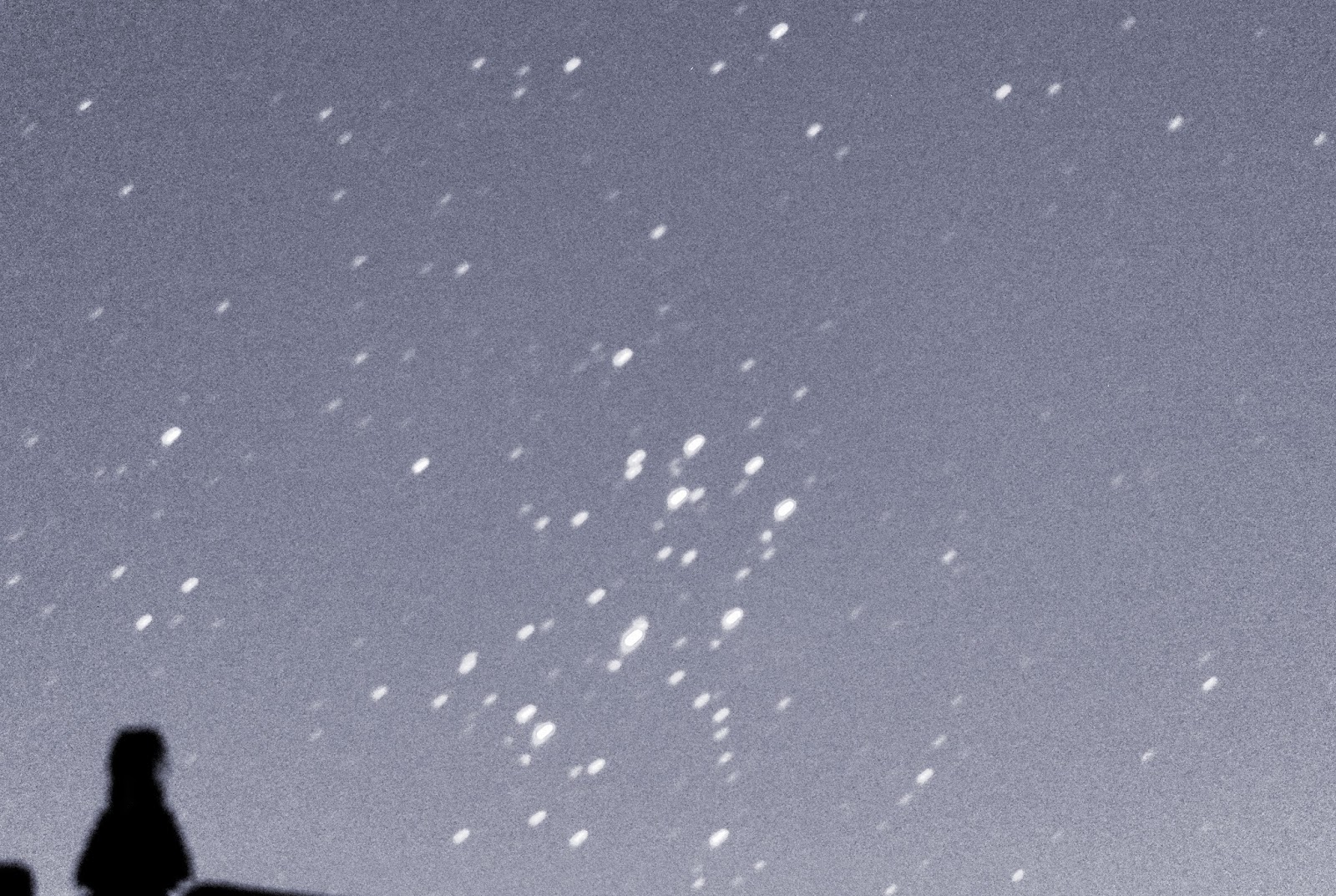
Unfortunately, the M15 shot missed the target!
August 15th 2200 GMT
I went out in an attempt to photograph some Perseids. I did not see any, although I saw a non-shower meteor. Lights from a nearby disco were illuminating the sky right by Cassiopeia – the very area I was trying to snap. I took some shots of the area and also proceeded to “attack” Perseus, Triangulum and Aries, overhead, Hercules and western Pegasus.
I also saw a satellite pass.
The Cassiopeia shot was composed of four exposures.

The Perseus shot was a close-up at 50mm focal length and was composed of 6 frames.

A similar shot of Aries and Triangulum was composed of 7 frames.

The shot of northern Cygnus was similar and was composed of 3 frames.

Back to 18mm, I managed to capture the Milky Way around Cygnus and Lyra.

Another process from the same stack revealed the constellations of Cygnus and Lyra.

A further 4 images were stacked to capture Lyra with parts of Hercules and Ophiuchus

5 images were used to create this image of Aquila and its surrounding constellations but I was especially pleased to capture the Coathanger.

Just east of this region is Pegasus. Apart from more of the same the globular cluster M15 is there somewhere.

August 12th
I'd tried to see Perseids a few times but it wasn't until I went out at 2220 GMT until I saw any. The main problem with earlier sessions was that there was too much cloud and I had to abandon sessions.
I saw 8 shower meteors from mag 3 to mag -3. The brightest one left a smoke
trail. All trails were unusually short, compared to previous years.
I also saw 5 satellites, including an Iridium flare.
I missed my DSLR.
Aug 11th 2200 GMT
There were truly awful conditions, with a limiting magnitude of 1.5, improving to 2.5 during the session. I saw 2 short meteors in Cassiopeia and one in Cygnus that could have been sporadic. All were about mag 1.5.
August 11th 1445 GMT
As the day before, it took a long time for conditions to clear and, even then, some haze still remained. The sunspot group appeared as one as it was about to rotate from view.

August 10th 1445 GMT
Conditions were poor and demonstrated exactly why bin scanning and drawing is so useful. The sunspots were approaching the solar limb and apparently merging. It is possible that I could have missed some fainter sunspots that I could have seen under better conditions.

August 9th 1045 GMT
Conditions were somewhat hazy when I bin scanned the Sun and I noticed that the sunspot pattern had changed, yet again.

August 9th 0130 GMT
I had another look for Perseid meteors but didn't see any, despite a few being reported online.
August 8th 2200 GMT
I went out I with my binoculars but my main idea was to see some early Perseids. Unfortunately, I didn't see any. The sky wasn't that clear either. Melotte 20 was clear enough but it took me several attempts to find M34. The Double Cluster did not show well. I could see some of the Andromeda Galaxy (M31) but the Wild Duck Cluster (M11) did not show well. Maybe it wasn't such a bad night to be missing my DSLR.
August 8th 1200 GMT
With a DSLR in for repair, one of our compact digital cameras packed up. The remaining one had blemishes on the lens, so I was unable to take any full disc solar shots, so I took some close-ups of the Sun using my PST. The stand-out features were the sunspots but I hoped to catch a few more “on film”.
Fortunately, some great prominences and a filament turned up in the photos.


August 8th 0720 GMT
Back from holiday, I was reunited with my kit and bin scanned the Sun in a clear sky. I was able to see five sunspots, four forming a nice active region.

August 7th
I reprocessed a solar hydrogen alpha shot from April 15th 2012.
August 6th
I reprocessed a solar hydrogen alpha shot from April 5th 2012.
August 5th
I reprocessed two solar hydrogen alpha photos from September 27th 2011.

August 4th
I reprocessed a solar hydrogen alpha photo from September 25th 2011.
August 3rd
I reprocessed a solar hydrogen alpha photo from September 17th 2011

August 2nd
I reprocessed a solar hydrogen alpha photo from September 14th 2011

... and September 17th 2011.


