July 30th 1630 GMT
There had been a period of bad weather but it cleared enough to show a couple of sunspots.
July 28th 0955 GMT
Conditions were quite poor, with a lot of moving cloud but I still managed to find 3 sunspots in my bin scan.
July 27th 0910 GMT
A solar bin scan in cloudy conditions did not reveal any sunspots.July 27th 0000 GMT (2300 local time)
I was hoping for some constellation shots but the huge filaments of cloud meant that few constellations were visible. The Moon was low, so the obvious thing to do was photograph the Moon! I started off with my compact digital camera and Mak using afocal projection. I stacked 10 of 27 frames to get this result:
I took a total of 180 frames afocally with my DSLR.
The first shot was a set of mostly underexposed full disc shots. I stacked 34 of 37.

The second shot was a set of 4 close-ups around Tycho stacked.

The third shot was composed of 6 frames of 20 stacked.

This mosaic was composed of 12 frames. By this time, I was just about getting exposure and ISO settings in the right ball park.

This full disc shot was composed of 25 frames.


This was composed of 12 of 14 frames.

The final shot was composed of 8 frames of 14.

I found that for many of the photos the red channel gave the most detail on the DSLR, a departure from my usual findings.
July 26th 1655 GMT
I checked the Sun with the Mak and filters and did my "formula" shots, stacking 9 of 15 full disc frames and 9 of 12 close-up frames to produce these results.

July 25th 1110 GMT
New sunspot activity was visible near the eastern limb.
July 24th 1140 GMT
There was some moving cloud but I was able to see some sunspots, although the larger one had rotated from view.
July 23rd 2150 GMT
I tried the DSLR on 70mm again but I tried full aperture and 1/500 second exposure at ISO 100. I took 29 frames and stacked the best 22. I still didn't get any craters but got a bit more detail.
July 23rd afternoon
After a cloudy morning, there was patchy could in the afternoon. A solar binocular scan revealed a new sunspot pattern.
July 22nd 2030 GMT
The Moon rose while I was walking our dog, so I went in and grabbed the Mak and a camera. Unfortunately, cloud moved in before I could get a full disc shot and this was all I could rescue.
July 21st 2050 GMT
After a hard day's tree felling, I was too tired to carry a telescope out the front, so I just had a go with my DSLR. I used short exposure and maximum focal length (70mm).
Jul 21st 1620 GMT
I checked the Sun with the Mak and saw 3 large sunspots. I took 9 full disc shots and stacked the best five.
July 20th 2100 GMT
I took 20 full disc lunar shots with my Mak and compact digital camera and stacked the best 9 using Microsoft ICE. Further processing was done using Paintshop Pro and GIMP.
I also took some full disc and close-up frames using afocal projection and the DSLR. The full disc shots were overexposed but some close-ups worked well.


July 19th 0640 GMT
I bin scanned the Sun. In addition to changes due to solar rotation, I saw a small sunspot close to the larger one.
July 18th 2050 GMT
I had some difficulty with my Moon shot, necessitating a computer restart. I took 8 imaging runs using a webcam and Startravel 80 and stitched and stacked the best 5. I finished off with GIMP.
July 18th 0750 GMT
There was a bit of haze but I managed to see two large sunspots when I did a binocular scan.
July 17th 1230 GMT
I checked the Sun with the Mak and found that the sunspots showed umbral/penumbral shading. I took some full disc shots and a set of close-ups. The full disc shots did not stack, so were composed from a single frame.

July 16th 2050 GMT
I took some full disc lunar shots and stacked 2 of 13 to produce this final image.
July 16th 0850 GMT
I checked the Sun with the PST and saw that it was more active than when I last checked, with many small prominences. The large sunspot was clearly visible and surrounded by plages. I took several full disc and close-up shots with the compact digital camera.The full disc shot was combined from 4 of 9 images and was rather better than recent efforts but the close-ups were all over-exposed.

July 16th 0700 GMT
I bin scanned the Sun and saw that there was a new sunspot, as well as the existing two having rotated.
July 15th 2050 GMT
The conditions were hazy but I managed to stack 16 of 17 full lunar disc images to produce this final image:
July 15th 0745 GMT
I bin scanned the Sun to find sunspot activity was visible, with one sunspot near the centre of the solar disc.
July 14th 1535 GMT
No too pleased with my afocal shots of the Sun with my DSLR, I went back to the compact digital camera and experimented with different ISO values and exposure times.


July 14th 1410 GMT
I bin scanned the Sun through moving cloud but didn't see any sunspots.July 14th 2325 GMT
OK, it was tomorrow but I adjusted to get GMT. I did some constellation shoots and for the Plough and Bootes, I stacked multiple images with Registax 5. Conditions were not as good as I'd hoped, with a lot of mist around, so I avoided the worst parts. I used ISO 400 and 30 seconds exposure for all shots and did final processing in GIMP.First was the Plough:

Next was Bootes:

Next was Ursa Minor, my best ever:

The final shot catches Delphinus (best ever) and Sagitta:

July 13th 2145 GMT
I started a twilight session by snapping the Moon afocally. I chose the best shot of 12, as it was better than the other 11 stacked! I applied the usual processing to end up with not too bad an image.
The webcam efforts were somewhat blurry and the session was curtailed when the Moon got too low.


I rounded off the session with Saturn. I tried using a 2x Barlow lens, as I had with Jupiter during the winter. However, it was dancing like John Travolta, so I didn't capture any surface detail, nor the Cassini division but at least it wasn't my worst ever shot and it was nice to finally get some sort of result with the SPC880.

July 13th 1000 GMT
I checked the Sun with the PST and saw some plages and a small but nice prominence pattern. I took some full disc frames with mt DSLR but am really missing the old compact digital camera that seemed particularly suitable for catching hydrogen alpha detail.
July 13th 0905 GMT
In clear skies, I bin scanned the Sun but didn't see any sunspots, although there were some faint ones on the Big Bear images.July 12th 2030 GMT
Conditions were quite hazy and the low elevation of the Moon didn't help either but I managed a full disc shoot combining the best 12 of 18 frames.
July 12th 1700 GMT
I checked the Sun with my PST. It wasn't as active as the day before but there was some activity in the top left quadrant. I tried some close-ups for a change.


July 12th 1145 GMT
I bin scanned the Sun in a clear sky but didn't see any sunspots. The Big Bear images showed only small ones.July 11th 1455 GMT
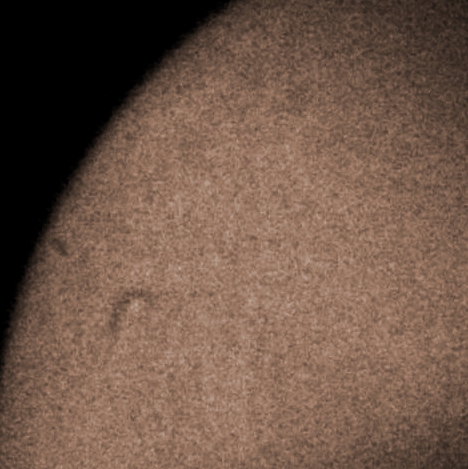
I checked the Sun with the PST. I could see a small prominence and there was an active region where the sunspots had been. However, the photo didn't do the view justice, even though the filaments are visible.
July 11th 0750 GMT
I bin scanned the Sun through thin cloud but could not see any sunspots.July 10th 1650 GMT
I had a busy day but was finally able to do a white light solar shoot late afternoon. The Sun was still active but the sunspot pattern had changed.
July 9th Early Morning
A solar bin scan revealed that the sunspot pattern had changed again.
July 8th
Bin scanned the Sun in the afternoon and saw that the sunspot pattern had changed again but really wished I had my Mak with me.
July 7th 0900 GMT
I did some full disc solar white light shots and some close-ups. The view through the telescope was quite amazing, far better than in binoculars. The full disc shot was composed from the best 10 shots of 15 and the close-up was composed from the best 5 of 12.

July 7th
I processed two photos from July 5th from a beach in Brittany that looked like some features on Mars.

July 6th 0850 GMT
I bin scanned the Sun and was amazed to see that the sunspot patterns had changed so much in little over a day.
July 5th 2145 GMT
I
went out at 2145 GMT for a constellation shoot and bin scan.
Attempted
constellations were: Cassiopeia, Plough, Ursa Minor, Bootes, Scorpius,
Sagittarius, Aquila, Cygnus, Delphinus. The attempts at the Plough and Bootes failed and the others weren't as good as I hoped because of a mis-set focal ratio on the camera. For example, I could only catch part of Cygnus.


I
spotted Alcor/Mizar and the summer doubles. I didn’t see any deep sky objects
around Cassiopeia but just made out the Ring (M57) in Lyra. Cygnus was so
overwhelmed by Milky Way stars that it was impossible to discern M29 or M39.
M11 stood out in Scutum and I saw lots of open and globular star clusters
around Sagittarius but (of course) could not remember which was which because I
hadn’t had skies that clear for ages!
I
even saw the Andromeda Galaxy (M31) low down in the north.
Finally,
Saturn clearly showed rings but I couldn’t see Titan.
July 5th
I finally saw the solar active region in binoculars that everyone had been raving about.
July 2nd
I reprocessed two solar hydrogen alpha images from September 25th 2013.


